A Brief History and Introduction


The earliest references to perinatal mental health can be traced to the Ebers Papyrus (c. 1500 BCE; Figure 1). In the 11th century, the Italian gynecologist Trota of Salerno already described the role of shame and self-stigmatization in perinatal suffering (Figure 2). Over time, channels for parental support diversified—from printed guides such as The Canadian Mother and Child (Figure 3) and Dr. Spock’s works to contemporary public health resources (e.g., the National Institute of Public Health of Québec’s [INSPQ] From Tiny Tot to Toddler: From Pregnancy to Age Two). Supporting families during the perinatal period requires not only up-to-date knowledge and evidence-based practices, but also formats aligned with today’s parents’ concerns, preferences, and time constraints. This is the rationale behind the Parents and Babies Program.

What Is the Parents and Babies Program?
Parents and Babies (https://toimoibebe.ca/en/) is a free, bilingual (French/English) online program for pregnant women and their partners designed to promote emotional well-being during the transition to parenthood (Toi, Moi, Bébé / You, Me, Baby, 2024). As a public health tool, the program aims to support well-being at the population level. As a clinical adjunct, it may contribute to the prevention—and potentially the treatment—of perinatal depressive symptoms. The program targets women and families seeking practical, accessible tools for a period often associated with stress, identity reorganization, and interpersonal change.
Developed by a multidisciplinary team of researchers and clinicians at the CHU Sainte-Justine Research Center (Azrieli Research Center), Parents and Babies is an in-depth adaptation and enhancement of the evidence-based Mothers and Babies program (Muñoz, Barrera, and colleagues) (Barrera et al., 2015). The project was initiated and led by Sylvana M. Côté, in close collaboration with clinical co-lead Martin St-André and a multidisciplinary team including clinical nurse leader Valérie Samson (Côté et al., 2024). The program received support from the Department of Obstetrics and Gynecology at Sainte-Justine’s University Hospital Centre, the largest mother-child hospital and research center in the province. The center ensures the clinical integration of the program across both clinical care and population-level services, facilitating its implementation within existing perinatal care pathways and public health initiatives. The Ministry of Health, and specifically its Centre of Expertise in Mental Health Information Technologies (Centre d’expertise en technologies de l’information en santé mentale : CETI) is responsible for supporting the program’s digital infrastructure, including the development, deployment, and maintenance of the web-based platform used to deliver the intervention.
Components of the Program
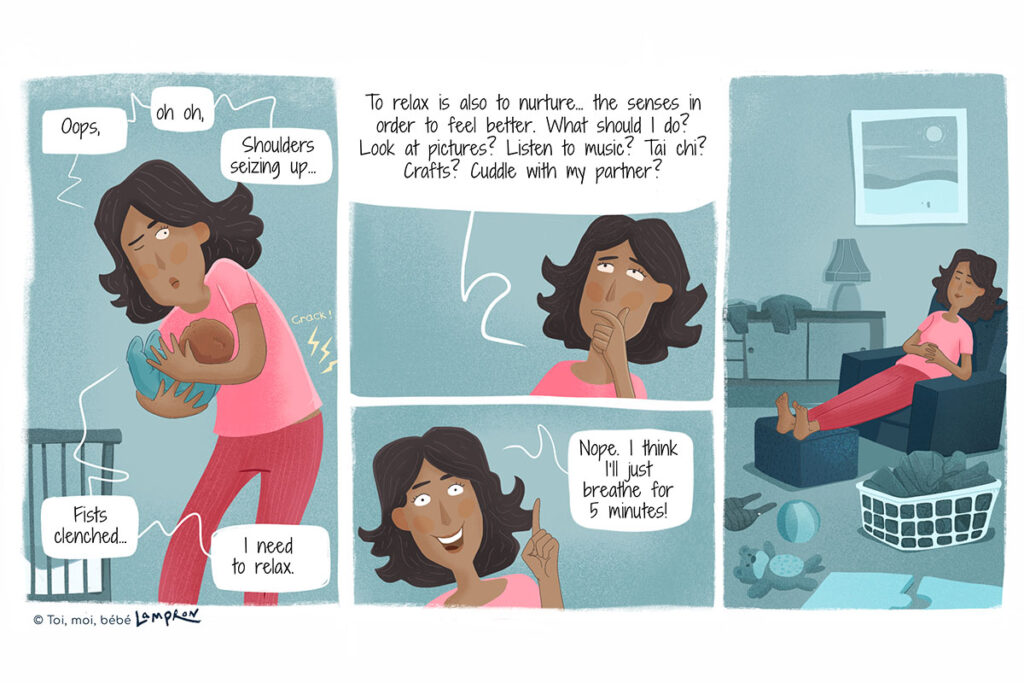
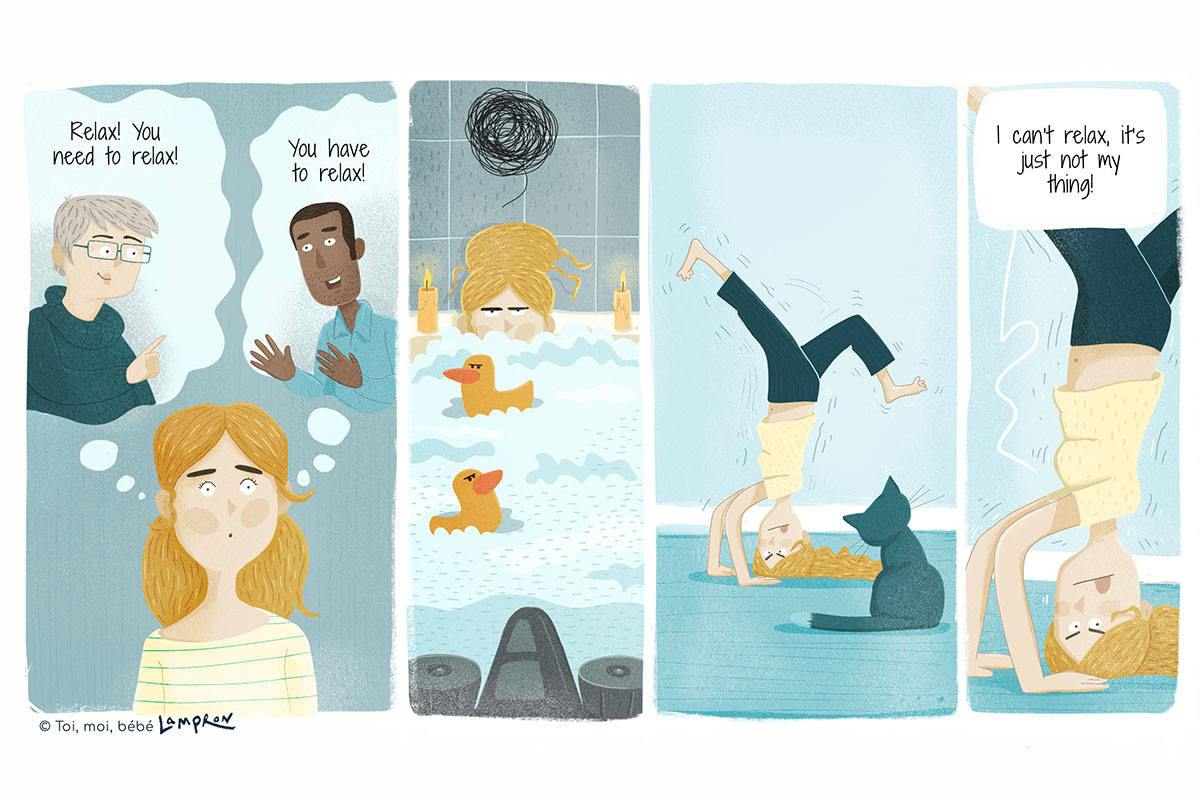
Perinatal mental health presentations are highly heterogeneous in etiology, phenomenology, severity, and comorbidity. To address this diversity, Parents and Babies offers flexible, accessible self-learning modules using multiple formats—brief didactic content, videos, audio recordings, interactive exercises, tip sheets, and resource sheets—designed to accommodate different learning styles and diverse family configurations. Attention is paid to different family structures and parenting models. The application of skills is illustrated through original comic strips that present contrasting problem-solving strategies involving relaxation and communication (Figures 4 and 5).
The program draws primarily on cognitive-behavioral therapy while also integrating mindfulness and self-compassion approaches from third-wave therapies. It is structured around three complementary targets:
- Know-how: Practical coping skills including the ability to identify and work with unhelpful thoughts, increase pleasant activities, express needs clearly, and mobilize support networks.
- Life management skills: Broader capacities for engaging with reality as it is and adapting constructively to present-moment demands, including affect tolerance, embodied emotional safety, gradual exposure to difficult situations, and discernment.
- Foundational knowledge: Basic information about common perinatal mental health conditions, typical emotional challenges during the transition to parenthood, and key aspects of early child development, including stress factors such as infant crying and regulatory difficulties.
Heavily influenced by third-wave therapies, the life management component offers a multimodal introduction to mindfulness, relaxation, and self-compassion skills rooted in contemplative traditions. One of the program’s co-authors (St-André) teaches Zen and has trained since 1999 at the Montreal Zen Center and with Marsha Linehan (substack.com/martinstandre).
Navigating the Website: For Families and Professionals
Parents and Babies (or You, Me, Baby on the website) was designed for families with limited time and can also be used by healthcare professionals. Modules take approximately 20 minutes and can be completed intermittently and, in any order, either chosen by participants or recommended by clinicians. The literacy level has been revised to meet the needs of different populations (Toi, Moi, Bébé / You, Me, Baby, 2024).
How Can Clinical Teams Use the Program?
Parents and Babies was designed as a clinical adjunct for perinatal professionals. It was pilot tested at our clinic with numerous families presenting the usual range of perinatal psychiatric conditions: perinatal depression, anxiety disorders, personality disorders, post-traumatic stress disorder, and developmental crises underpinned by intergenerational, intrafamilial, or transcultural issues. The families served at our clinic are widely diverse in terms of background and configuration. The main users are typically mothers, though partners also show interest in the program, either as individual users or as support for the mother’s use.
In clinical practice, the program can be used to reinforce elements covered in person, such as cognitive distortions, emotion regulation, and communication. After familiarizing themselves with the program, clinical staff can recommend specific modules or exercises depending on the problems encountered. Supervision by the clinical team helps address motivational aspects and contingencies related to program use. With clinician support, users can explore the degree of exposure that maintains therapeutic engagement without excessive anxiety. Finally, our experience indicates that this online program provides a transitional space that can potentially extend the therapeutic relationship beyond face-to-face meetings.
The Parents and Babies Randomized Clinical Trial
Between 2021 and 2024, we conducted a randomized controlled trial in Quebec involving 510 pregnant women with moderate depressive symptoms (Edinburgh Postnatal Depression Scale [EPDS] scores 9–16) (Dessy et al., in press). Participants were randomized to receive the web-based Parents and Babies Program either with or without weekly motivational telephone support (i.e., telephone coaching). Data were collected prospectively via self-report questionnaires from baseline (second trimester of pregnancy) through 6 months postpartum. Additional information on perinatal maternal and infant healthcare utilization was collected at 6 months through the adapted Health Service Utilization and Cost of Care Questionnaire.
Key findings:
- Parents and Babies with coaching was not superior to Parents and Babies self- help.
- Parents and Babies (with or without telephone support) was superior to usual care: in adjusted regression models, EPDS scores were lower than in usual care.
- In women with subclinical to moderate clinical antenatal depressive symptoms, receiving a web-based cognitive-behavioral therapy-based program in addition to usual care can reduce depression postnatally[5].
- At 6 months postpartum, a substantial proportion of participants reported receiving additional mental health support (including psychotherapy); 74% and 90% consulted healthcare professionals for perinatal maternal and infant healthcare, respectively.
- Higher maternal educational attainment was associated with higher levels of use of infant healthcare services at 6 months.
- Among those using infant healthcare services , higher maternal education showed a trend toward higher odds of consulting a midwife.
- Compared with population-based trajectories of perinatal depressive symptoms reported in large community-based cohorts such as the pan-Canadian CONCEPTION study (Giesbrecht et al. 2022; Bérard et al., 2022), women in Parents and Babies trial—who all entered pregnancy with moderate depressive symptoms—showed a larger reduction in symptom between pregnancy and 6 months postpartum (Liu et al., 2023).
Our findings underscore the potential benefits of integrating routine screening and preventive interventions for pregnant women who present with moderate depressive symptoms. The Parents and Babies Program offer a brief, web-based option that can be delivered alongside usual perinatal care and may help modify depressive symptom trajectories in this higher-risk group. At the same time, the persistent association between lower educational attainment and reduced infant healthcare utilization at 6 months, points to a need for proactive case-finding, outreach, and linkage to pediatric and community services for socially disadvantaged mothers (Dessy et al, in preparation). From a frontline practice perspective, these results support closer collaboration between mental health, obstetrical, midwifery, and primary care providers to ensure that women with both elevated depressive symptoms and social vulnerability are systematically identified and offered accessible, relationship-focused support.
Recent Developments
In June 2024, a webinar brought together 350 participants from the Québec healthcare network, illustrating the strong interest in accessible tools for perinatal mental health. Building on this momentum, continuing education activities in 2025 and 2026 have focused on disseminating the program in perinatal clinical settings across Québec, as well as through CHU Sainte-Justine’s ECHO perinatal mental health tele-mentoring program (https://enseignement.chusj.org/fr/Formation-continue/Telementorat-ECHO/Sante-mentale-perinatale) (CHU Sainte-Justine, 2025).
These dissemination efforts have also facilitated research collaborations with the perinatology network to investigate the developmental and intergenerational origins of children’s health (https://odise.ca/en/about-us).
In parallel, a training plan led by a clinical nurse leader has supported further development of implementation tools: a 45-minute narrated asynchronous training module with an accompanying PDF document, a quick-reference aid, five new video capsules presenting the program to facilitate its use, an information document intended for families, and a complete audio version of the program. We also developed a virtual reality pilot project to further enhance participant engagement, in collaboration with a British computer engineering team (Zorzi et al., 2025). Clinical content will also be examined over the coming year to consider possible developments, such as addressing the traumatic dimension in perinatal care.
International interest has already been expressed, particularly in the French-speaking world and the rest of Canada. Discussions are currently underway with a team in Africa for the cross-cultural adaptation of Parents and Babies.
Relevance for the International Infant Mental Health Community
Parents and Babies represents a translatable model for bridging population-level prevention and individualized clinical care within a publicly funded healthcare system. The program’s bilingual implementation across Québec demonstrates that digital perinatal mental health tools can be deployed at scale while maintaining cultural and linguistic accessibility—a priority for multilingual jurisdictions worldwide (World Health Organization, 2022).
Our adaptation of the Mothers and Babies evidence base involved substantial modifications that may inform international implementation efforts:
- Adjusted literacy levels to reach diverse educational backgrounds
- Explicit inclusion of perinatal partners (not only mothers), reflecting evolving family structures
- Integration of contemplative practices (mindfulness, self-compassion) alongside cognitive-behavioral therapy
- Embedded implementation support through the ECHO tele-mentoring network to build frontline clinician capacity for blended care
The trial’s equity findings carry relevance for international infant mental health. Maternal education predicted not only mental health service use but also downstream infant healthcare access at 6 months postpartum, suggesting that perinatal depression interventions function as potential leverage points for improving early childhood health trajectories—but only if implementation actively mitigates socio-economic barriers (World Association for Infant Mental Health, 2016). This aligns with World Association for Infant Mental Health (WAIMH) priorities around equity, early prevention, and family-systems approaches to infant mental health and development.
Within CHU Sainte-Justine’s ECHO perinatal mental health program, Parents and Babies is presented as one of several resources that clinicians can use with families. Clinical nurse leaders play an important role in demonstrating how the program can be recommended to parents, integrated into follow-up visits, and combined with other interventions without replacing in-person care. This combination of a structured digital program and ongoing tele-mentoring offers a replicable workforce development strategy that extends specialist perinatal mental health knowledge to frontline providers in underserved regions, addressing capacity gaps common in low- and middle-income countries (Chamberlain et al., 2019). Finally, our virtual reality pilot (Zorzi et al., 2025) explores next-generation engagement methods that may address avoidance and dose issues in digital interventions, offering potential applications across diverse perinatal populations.
Conclusion
For the perinatal population that suffered greatly during the pandemic, the development of telemedicine and online tools were major advances. These adaptable tools have led to an evolution in the range of prevention tools and services available to young families. While online programs will obviously never replace direct services, they can be “a little help that goes a long way.”
The development of Parents and Babies Program was the result of rigorous blending of complementary perspectives: research and clinical practice, public health and intervention, developmental sciences and graphic arts, and behavior change techniques and ancestral contemplative strategies. This cross-fertilization also takes us a step further in the inclusion of perinatal partners. The program also helps build necessary bridges between perinatal mental health and early childhood development.
The development of Parents and Babies will be an ongoing process. This development will continue in a socially diverse and clinically heterogeneous context. We need continuous feedback from families and healthcare professionals. Continuous evaluation of the project will ensure it fits the needs of the population in terms of prevention and clinical support for vulnerable families.
Acknowledgments
Tatiana Dessy, PhD (Epidemiology) & Analyst (CHU Sainte-Justine Research Center); Valérie Samson, Clinical Nurse Leader, Perinatal and Adult Mental Health, Department of Nursing (CHU Sainte-Justine), Camille Dinello-Goupil, Coordinator of the Toi.Moi.Bebe project and of the ODISE Network. We also acknowledge the work of Julie Béland (Université de Montréal), Catherine M. Herba, (Université du Québec à Montréal, UQAM), Tina C. Montreuil (McGill University), Anna L. MacKinnon (CHU Sainte-Justine Research Center and Université de Montréal), and Myriam Clément (Université du Québec en Outaouais, UQO).
References
Barrera, A. Z., Wickham, R. E., & Muñoz, R. F. (2015). Online prevention of postpartum depression for Spanish- and English-speaking pregnant women: A pilot randomized controlled trial. Internet Interventions, 2(3), 257–265.
Bérard, A., Baumgartner, C., Gavin, A. R., Pells, M., Waddell, C., Giesbrecht, G., … Lebel, C. (2022). Pregnancy during the COVID-19 pandemic (CONCEPTION) cohort: Study protocol and methodological considerations. BMC Pregnancy and Childbirth, 22, 615. https://doi.org/10.1186/s12884-022-04935-1
Chamberlain, C., Gee, G., Harfield, S., Campbell, S., Brennan, S., Clark, Y., … Brown, S. J. (2019). Parenting after a history of childhood maltreatment: A scoping review and map of evidence in the perinatal period. PLOS ONE, 14(3), e0213460.
CHU Sainte-Justine. (2025). Santé mentale périnatale: ECHO™ CHU Sainte-Justine. Retrieved from https://enseignement.chusj.org/fr/Formation-continue/Telementorat-ECHO/Sante-mentale-perinatale
Côté, S. M., St-André, M., Montreuil, T. C., Béland, J., Samson, V., & Herba, C. M. (2024). Toi, Moi, Bébé / You, Me, Baby [Online perinatal mental health program]. CHU Sainte-Justine, Azrieli Research Center.
Dessy, T., Dennis, C.-L., St-André, M., Montreuil, T. C., Herba, C. M., MacKinnon, A. L., Clément, M., Legault, O., Tchouangue-Dinkou, G.-D., Samson, V., Charest, L., Collet, O., Pain-Andrejin, R., Bello, A.-H., Jamal Eddine, S. A., & Côté, S. M. (2026). Maternal perinatal mental healthcare and infant healthcare access among women with moderate symptoms of prenatal depression. Manuscript in preparation.
Dessy, T., Montreuil, T. C., St-André, M., Herba, C. M., MacKinnon, A. L., Clément, M., Boucoiran, I., & Côté, S. M. (in press). Effectiveness of a web-based preventive postpartum depression program in pregnancy, with/without telephone coaching: A randomized controlled trial. BMJ Open.
Giesbrecht, G. F., Rojas, L., Patel, S., Kuret, V., MacKinnon, A. L., Tomfohr-Madsen, L., & Lebel, C. (2022). The impact of COVID-19 on maternal mental health during pregnancy: A comparison between Canada and China within the CONCEPTION cohort. International Journal of Environmental Research and Public Health, 19(19), 12673. https://doi.org/10.3390/ijerph191912673
Liu, C. H., Erdei, C., & Mittal, L. (2023). Perinatal trajectories of maternal depressive symptoms in prospective, community-based cohorts across 3 continents. JAMA Network Open, 6(10), e2338647. https://doi.org/10.1001/jamanetworkopen.2023.38647
Toi, Moi, Bébé / You, Me Baby (2024). How the program works. Retrieved from https://toimoibebe.ca/en/page/fonctionnement-du-cours/
Toi, Moi, Bébé / You, Me, Baby. (2024). You, Me, Baby – the online course [Toi, Moi, Bébé – le cours en ligne]. Retrieved from https://toimoibebe.ca/en/home/
World Association for Infant Mental Health. (2016). WAIMH position paper on the rights of infants. Perspectives in Infant Mental Health, 24(1), 1–4.
World Health Organization. (2022). World mental health report: Transforming mental health for all. World Health Organization.
Zorzi, C., Jean, J., Côté, S. M., St-André, M., & MacKinnon, A. L. (2025). Virtual reality for the treatment of perinatal mental health: A rapid scoping review. BMJ Open, 15(12), e094901.
Authors
St-André, Martin, MD
Medical Director, Perinatal and Early Childhood Psychiatry Clinic, CHU Sainte-Justine; Director, Perinatal Psychiatry Fellowship Program, Université de Montréal,
Canada
Côté, Sylvana, PhD, FRSC
Professor, School of Public Health and CHU Sainte-Justine Research Centre and Université de Montréal,
Canada