
Introduction
Fatherhood Roles in South Africa
Like all social constructs, parenting roles are shaped by complex, interrelated factors. In South Africa, a number of studies continue to demonstrate links between fatherhood, financial responsibility and the role of provider (Makusha, 2024; Ncayiyane & Nel, 2024; Thompson et al., 2024). Scholars attribute this social construction to intersecting historical, cultural and economic factors. Some argue that the attribution of provider roles to fathers has traditional roots in patriarchal systems (Osbourne & Ahinkorah, 2024). Others attribute it to the impact of Apartheid on labour migration (Muchemwa & Odimegwe, 2026) and assert that fatherhood in Africa has historically encompassed far more than provision, with a strong focus on moral and social development (Malinga and Ratele, 2022). Regardless of its origins, the ‘provider identity’ of fathers predominates alongside gendered ideas about care provision as women’s work (Van den Berg et al., 2024). This has raised gender equity concerns, with the State of South African Fathers Report highlighting that while 85% of South African women report that they supported their children financially, fathers are not taking up a larger proportion of caring responsibilities in response (Van den Berg et al., 2024).
The association between fatherhood and financial obligations in South Africa do not relate exclusively to financial provision for the child’s care needs, nutrition, education and health (Osbourne & Ahinkorah, 2024). For many families in South Africa, pregnancy and birth is associated with culturally defined financial obligations such as inhlawulo (Makusha, 2024). Inhlawulo is an offering, usually a financial contribution, paid by the paternal family to the maternal family in cases of extra-marital pregnancy in acknowledgement of paternity (Makusha, 2024; Malinga & Ratele, 2022). Such local practices function to legitimise paternal recognition and govern access to children and thus, often determines what roles a father occupies and plays in the life of a child (Malinga & Ratele, 2022).
Economic Stress, Fatherhood and Wellbeing
The ‘provider identity’ linked to fatherhood in South Africa exists alongside stark economic hardships in the country. One in every three job-seeking South Africans is unemployed (Matyana & Thusi, 2023). Such realities inevitably impact the ability of many fathers to meet socially prescribed provider roles (Muchemwa & Odimegwu, 2026). In the context of practices such an Inhlawulo, financial hardship can also restrict a man’s capacity to formalise recognition of paternity, with consequences for access and co-residence with children (Makusha, 2024).
Makusha (2024) argues that it is the complex intersection of provider identities, cultural expectations and difficult economic conditions centrally determine a father’s ability to take up a caregiving role in his child’s life. The complex interplay may also contribute to wellbeing of fathers in South Africa. A number of studies have demonstrated an anticipated link between financial circumstances and mental wellbeing for men and fathers in South Africa. One study found that men living in South African townships were highly vulnerable to poor mental health outcomes and problematic alcohol use, explained by stressful economic and social conditions (Oyekunle et al., 2021). In another study, some fathers reported using alcohol as a means of coping with high levels of stress and restricted economic opportunities (Makusha, 2024). These responses suggest unmet needs for accessible psychosocial support tailored to men navigating early fatherhood under constrained circumstances.
Provider Identities, Fatherhood and Maternal and Infant Wellbeing
The link between financial stress, parental depression and negative child outcomes has already been established with regards to mothers of infants. South Africa has extremely high rates of maternal postpartum depression, with prevalence rates estimated at over 30% (Nweke et al., 2024). A South African study found higher rates of financial stress and precarity in depressed mothers and demonstrated anticipated associations to negative consequences for infant outcomes, in line with international findings (Gordon et al., 2021).
Similar patterns may be anticipated for fathers, given the qualitative studies which highlight the experiences of fathers amidst ‘provider identities’ and high rates of unemployment. Implications for paternal, maternal and infant wellbeing are anticipated. Advocates are highlighting studies that demonstrate the role of quality of care provided by fathers in attachment security, exploration, resilience, and behavioural problems and calls are being made to increase fatherhood involvement in Africa (Osbourne & Ahinkorah, 2024; Van Den Berg et al., 2024). As we search for improved mental health outcomes for infants and aim to support parental mental health to achieve this, it is important to better understand the care beliefs, financial circumstances and wellbeing of South African fathers of infants.
Methodology
In light of interest into the interplay between caregiving roles, economic circumstances and family wellbeing (infant, maternal and paternal wellbeing) in South Africa, this study sought to investigate the caregiving beliefs, financial circumstances and wellbeing of fathers of infants in South Africa. The study drew on data from the State of the World’s Fathers 2026 study – which surveyed 8000 parents from 16 countries, with ethical oversight governed by Equimondo (SOWF2026). Five hundred survey respondents were from South Africa, representing the country in age, region, race and economic demographics. For this study, all female respondents and all survey respondents who did not have a child aged 0 to 3 were excluded from the data set, resulting in a sample of 63 fathers with infants aged 0 to 3, living in South Africa. Descriptive statistics were run for participant demographics, agreement with caregiving belief statements, financial situation reports and wellbeing reports, using SPSS.
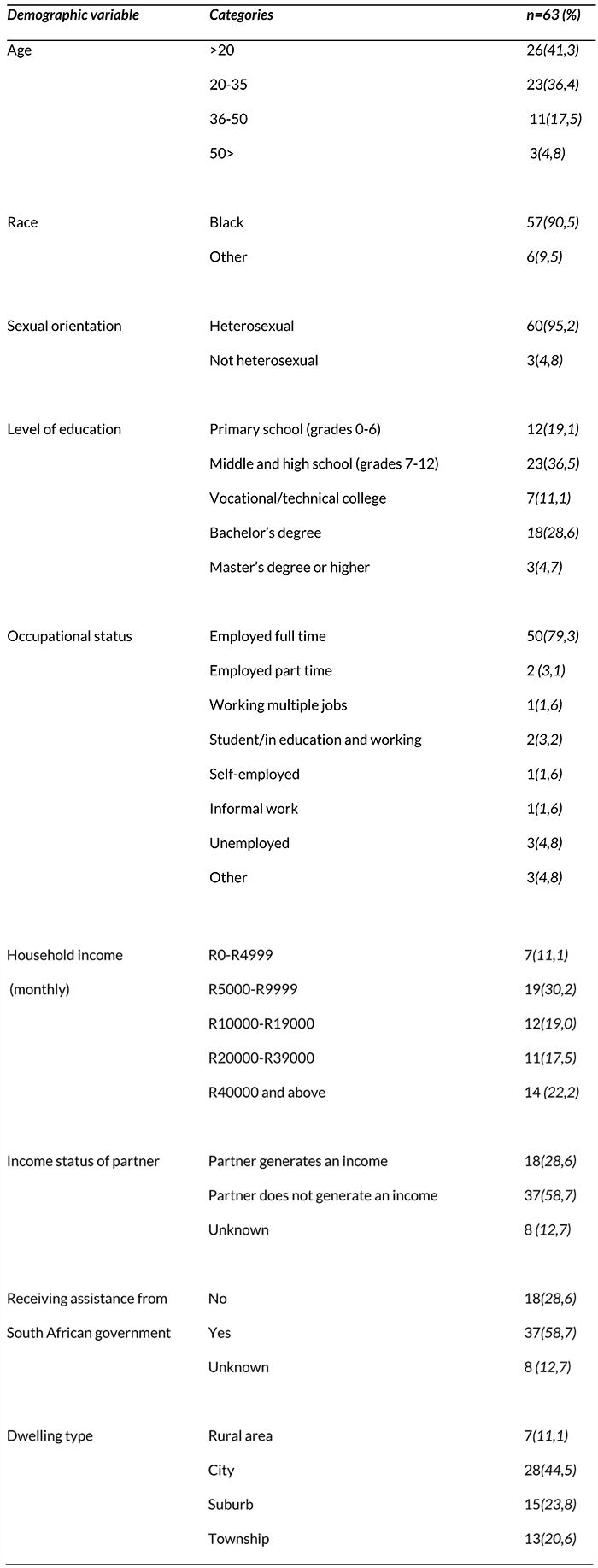
Sixty three of the 500 (12,6% of N=500) national survey respondents had a child aged between 0 and 3 years old. Over three quarters of the participants were under the age of 35. Ninety percent identified as Black African. Forty five percent of the sample had completed further education and training following completion of formal schooling. Over 40 percent of the participants (44,5%) reported living in a major South African city. Nearly eighty percent of the sample were employed full time (well above the national average), and over fifty eight percent of participants reported that their partner earned an income. Participant income roughly represented country income statistics in upper quintiles, with under-representation of the lowest income quintile. Over fifty seven percent of participants reported that they received financial assistance from the South African government. Over 95 percent of the participants identified as heterosexual.
Table 1. Demographic characteristics of participants.
Results
Financial situation of South African fathers of infants
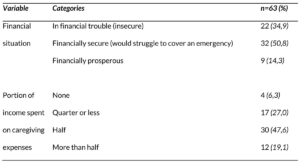
Nearly thirty five percent of fathers reported that they were in a financially insecure situation or were ‘in financial trouble’. A further seventeen percent would struggle financially if there was an emergency. Over sixty percent of fathers reported spending half of their income or more on caregiving responsibilities.
Table 2. Financial situation.
Caregiving beliefs of South African fathers of infants
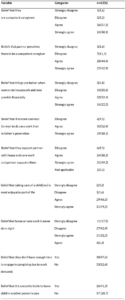
Survey respondents reported that they were involved with caring for their infant children but appeared to predominantly value their role as a financial provider. Ninety five percent of fathers felt they were competent at taking care of their child, and eighty seven percent felt that their partner believes they are competent at caring for their child. However, three out of four survey respondents (75% of participants) felt that it was better if men do paid work and women do care work at home and nearly forty percent of fathers reported that they ‘never seem to get it right’ when they do care or housework at home. Despite this, ninety percent of surveyed fathers believed it was more normal for men to do care work than it was in their fathers’ generation.
Over eighty seven percent (87,3%) of fathers surveyed felt they and their partner support each other as much as they can with house and care work. Ninety five percent of fathers surveyed reported that, most of the time, they felt caring for their child was the most enjoyable thing in their life. Nearly half of fathers (47,6%) felt work interfered with their care responsibilities. Over forty percent (41,3%) of fathers felt uncomfortable leaving their child in another persons’ care.
Table 3. Care beliefs.
Wellbeing of South African fathers of infants
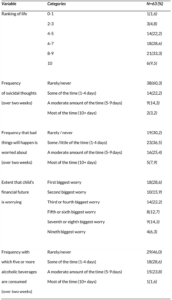
More than one in four fathers ranked their life negatively. Forty percent of survey respondents reported having thoughts of suicide at least once in the last two weeks. Seventy percent of survey respondents stated that they were worried about bad things happening. When asked about their greatest worry as a parent, nearly 1 in 3 fathers (28,6%) reported that their greatest worry was their child’s financial future. Two out of three survey respondents reported consuming five or more drinks containing alcohol on more than one occasion in the previous two weeks with 1 in 4 fathers (25,4%) reporting drinking more than five alcoholic drinks between 5 and 14 days out of 14.
Table 4. Father wellbeing.
Discussion
The findings reported here, drawn from a larger study on the State of the World’s Fathers, provides a useful window into the lives of South African fathers of young infants. The findings suggest increased engagement in caregiving activities by fathers, despite persistent endorsement of traditional gender roles. Fathers appear to believe that their caregiving competency lies in their ability to provide financially, and despite gaining pleasure from caring for their infant children, appear to lack confidence and social validation with regards to domestic care work in the home.
This seems to suggest that the preoccupation with financial provision, and a sense of inferiority in competence of home-based care work predominates, despite shifting gender norms and pleasure in care work. That is to say, fathers appear to be actively participating in caregiving while holding internalised norms that position this involvement as secondary to their provider role, and inferior to the direct childcare capabilities of their partners. As infant mental health clinicians, working with African fathers amidst shifting gender norms, it may be particularly important to provide interventions that scaffold confidence and a sense of competence. Interventions such as the Newborn Behavioural Observation system (Nugent et al., 2007) may be helpful in this instance.
The survey findings also forefront the economic pressures and financial insecurity faced by many fathers in South Africa. The persistent provider identity held by fathers of infants in South Africa, occurring alongside economic pressures and financial insecurity, may well account for high levels of psychological distress reported by survey respondents. The high levels of suicidal ideation, pervasive worry, and hazardous alcohol use in the cohort raise concern for fathers and their infants. The findings suggest that many fathers of infants in South Africa are parenting under conditions of pervasive stress, with limited support for their own mental health, with clear consequent implications for the mental health of their infants (Fisher, 2017). The findings highlight the need for infant mental health clinicians to actively include fathers in infant mental health services, screening for paternal distress, and creating spaces where fathers’ experiences of pressure and ambivalence can be processed.
Conclusion
This study provides insights into the realities faced by fathers of infants in South Africa. The findings highlight a complex picture of shifting gender roles regarding male involvement in care practices, amidst pervasive, entrenched provider identities. While many are embracing more active caregiving roles than previous generations, these shifts are occurring alongside enduring provider expectations and structural constraints. The study forefronts the complexity of the enduring provider identity in the midst of this precarious economic environment, hinting at potential paternal mental health implications. While causal inferences cannot be drawn, many fathers of infants in South Africa are navigating parenthood amidst significant economic and psychological strain.
For infant mental health practitioners working in this and similar settings, the findings underscore the importance of explicitly including fathers, with a focus on supporting mental wellbeing and boosting parenting confidence. Acknowledging the impact of financial stress in light of the pervasive provider identity, and validating their caregiving competency, could promote healthier developmental environments for infants.
References
Fisher, S. D. (2017). Paternal mental health: why is it relevant?. American journal of lifestyle medicine, 11(3), 200-211. https://doi.org/10.1177/1559827616629895
Gordon, S., Rotheram-Fuller, E., Rezvan, P., Stewart, J., Christodoulou, J., & Tomlinson, M. (2021). Maternal depressed mood and child development over the first five years of life in South Africa. Journal of Affective Disorders, 294, 346-356. https://doi.org/10.1016/j.jad.2021.07.027
Makusha, T. (2024). Young fatherhood, masculinities, and structural factors in South Africa. Frontiers in Sociology, Gender, Sex, and Sexualities, 9, 1-7. https://doi.org/10.3389/fsoc.2024.1410801
Malinga, M., Ratele, K. (2022). Fatherhood Among Marginalised Work-Seeking Men in South Africa. In: Grau Grau, M., las Heras Maestro, M., Riley Bowles, H. (eds) Engaged Fatherhood for Men, Families and Gender Equality. Contributions to Management Science. Springer, Cham. https://doi.org/10.1007/978-3-030-75645-1_15
Matyana, M., & Thusi, X. (2023). Unemployment and poverty in South Africa: Assessing the national development plan 2030 predictions. International Journal of Development and Sustainability, 12(6), 212-226.
Muchemwa, M., & Odimegwu, C. (2026). Reimagining good fatherhood: non-custodial black fathers’ experiences in South Africa. Social Dynamics, 1-20. https://doi.org/10.1080/02533952.2026.2650069
Ncayiyane, Z., & Nel, L. (2024). Young black fathers’ perceptions of fatherhood: A family systems account. Journal of Family Issues, 45(6), 1431-1452. https://doi.org/10.1177/0192513X231172955
Nugent, J. K., Keefer, C. H., Minear, S., Johnson, L. C., & Blanchard, Y. (2007). The newborn behavioral observations (NBO) system handbook. Paul H Brookes Publishing, Baltimore, MD, USA.
Nweke, M., Ukwuoma, M., Adiuku-Brown, A. C., Okemuo, A. J., Ugwu, P. I., & Nseka, E. (2024). Burden of postpartum depression in sub-Saharan Africa: An updated systematic review. South African Journal of Science, 120(1-2), 1-12. https://doi.org/10.17159/sajs.2024/14197
Osborne, A., & Ahinkorah, B. O. (2024). The paternal influence on early childhood development in Africa: implications for child and adolescent mental health. Child and adolescent psychiatry and mental health, 18(1), 1-8. https://doi.org/10.1186/s13034-024-00847-4
Oyekunle, V., Tomita, A., & Gibbs, A. (2023). High levels of poor mental health among young men in urban informal settlements in South Africa: A community-based study of social determinants. Psychology, Health & Medicine, 28(9), 2606-2620. https://doi.org/10.1080/13548506.2022.2088816
Richter, L., & Morrell, R. (2006). Baba: men and fatherhood in South Africa. Cape Town: HSRC Press.
Thompson Dr, U. A., Headman Mr, T., Tjemolane Mr, L., & Nyati Dr, L. H. (2026). Negotiating Fatherhood: Young Men’s Narratives of Care, Responsibility, and Struggle in a Low-Income South African Setting. Journal of Social, Behavioral, and Health Sciences, 20(1),1-18. https://doi.org/10.5590/JSBHS.2026.20.1784
Van den Berg, W., Ratele, K., Malinga, M. & Makusha, T., eds. (2024). State of South Africa’s Fathers 2024. Stellenbosch: Tataokhona.
Authors
Dawson, Nicola, PhD
Counselling Psychologist,
The Ububele Educational and Psychotherapy Trust and Stellenbosch University,
South Africa
Dippenaar, Wilmi,
Director,
South African Parenting Programme Implementers Network,
South Africa
Mamontov, Antonina,
Research Psychologist,
The Ububele Educational and Psychotherapy Trust,
South Africa