
Abstract
Infant mental health practice has historically centered the mother-infant dyad. Globally, cultural norms around gender, provision, and family structure have positioned fathers as peripheral to early caregiving, even as developmental science makes clear that paternal involvement independently shapes infant outcomes. A generational shift in society is creating new opportunities for fathers to be present, engaged, and recognized as caregivers from the beginning of their child’s life. Infant mental health practice has an opportunity to meet that shift and treat paternal involvement as a developmental variable to be actively cultivated.
This perspective draws on developmental evidence and sociocultural research to argue for culturally informed inclusion of fathers in infant mental health practice through a redefinition of masculinity. When fathers are engaged infants receive more consistent co-regulation, mothers experience reduced stress and isolation and families move toward secure, resilient relational patterns.
In many low-resource and culturally traditional settings, fathers remain under-engaged despite their profound influence on early relational health. Family and community interventions offer powerful, culturally resonant entry points to normalize attuned, compassionate, and developmentally responsive fathering. This perspective argues for a paradigm shift toward intentional father inclusion, drawing on faith narratives, developmental science, and community health models (e.g., Newborn Observation-informed work in Pakistan) and supportive policies.
Structural, attitudinal, and systemic shifts are needed to move father involvement from exception to expectation. By drawing from our collective clinical and cultural experiences, we highlight interventions for intentional support of father-child bonding which are applicable to healthy family functioning across communities. We believe this framing offers a powerful and universal message, emphasizing themes that resonate with families from many backgrounds.
Introduction
Early caregiving relationships exert a profound influence on child development and mental health. Historically, the study of parent–child bonding focused primarily on mother–child dyads, reflecting patriarchal social structures that conferred family roles of fathers as providers and mothers as caregivers. As gender roles evolve globally and more women enter the workforce, father involvement in caregiving has increased, challenging earlier family models and division of labor. Clinical practice has gradually begun to consider fathers as active participants in early relational health.
Despite these societal and clinical shifts, there is scant research on early caregiving relationships focused on father involvement. This is particularly true in low- and middle-income countries, where much of the world’s child population resides and where cultural, economic, and structural factors influence paternal engagement in unique ways. In this paper, we explore father involvement in infancy across diverse cultural contexts, drawing on developmental perspectives, clinical experience, and policy examples to highlight culturally informed pathways for strengthening father–infant relationships as the foundation for healthy family functioning.
Role of Fathers in Infant and Early Childhood Mental Health
The developing brain is exquisitely sensitive to early childhood relational experience. Responsive caregiving promotes secure attachment, language development, emotion regulation, and stress physiology. Although maternal caregiving has been the sole focus of attention until recently, it is increasingly recognized that paternal caregiving brings a distinct and equally important regulatory influence (Shorey & Ang, 2019). Structural or cultural factors that have excluded fathers during pregnancy, birth, and the early postpartum period have unwittingly deprived infants and families of avenues for co-regulation, shared caregiving, and early paternal bonding, with downstream implications for child, father and family wellbeing.
Child development research provides unequivocal evidence for the importance of father involvement independent of maternal caregiving (Yogman et al, 2016). A meta-analysis of paternal sensitivity demonstrated significant associations with children’s cognitive functioning, language development, executive function, and emotion regulation, with effects independent of maternal sensitivity (Rodrigues et al., 2021). Further, father–infant interactions as early as three months predict cognitive outcomes at 24 months after controlling for maternal involvement (Sethna et al., 2017). Additionally, longitudinal data indicate that active paternal engagement is associated with fewer behavioral problems, fewer psychological issues in young women, and stronger cognitive development across childhood (Sarkadi et al., 2008).
On the other hand, poorer paternal engagement early in infancy is linked to elevated risk for adverse outcomes. Ramchandani and colleagues (2013) found that low paternal involvement by three months predicted negative behavioral outcomes by age one, increased infant mortality, and lower child wellbeing. In the United States, children growing up without involved fathers constitute a disproportionately high percentage of homeless youth, school dropouts, and youth suicide deaths, emphasizing the public health costs of paternal disengagement (McLanahan, et al, 2013).
Paternal mental health is often overlooked and may be a pathway for risk and resilience. Paternal postpartum depression affects approximately 8–10% of fathers globally and is more prevalent in low- and middle-income countries (Cameron et al., 2016; Husain et al., 2025). Untreated paternal depression compromises bonding, partner support, and child emotional development. Conversely, paternal postpartum bonding is positively correlated with maternal bonding and inversely associated with maternal stress, underscoring the relational benefits of father involvement for the entire family system (Bieleninik, et al, 2021).
Given the role of family processes in identity development and the intergenerational transmission of trauma, strengthening father–infant bonding may be especially important for promoting resilience and disrupting cycles of adversity. Fathers represent underutilized potential within the family system, particularly in developing contexts, where structural and cultural barriers often impede involvement.
Cultural Models of Fathering and Clinical Implications
Cultural models of father involvement specify ideal paternal roles, provide evaluative frameworks, and articulate the perceived benefits of paternal engagement. These models intersect with broader life stressors—economic precarity, discrimination, migration, and cultural displacement—and are shaped by internalized ethno-theories of masculinity (Pleck, 2010). The absence of father-specific caregiving models can undermine paternal confidence and limit opportunities for engagement, even when desire is present.
Drawing from collective clinical and cultural experience, we argue for intentional, culturally informed interventions that support father–infant bonding across communities. Education, therapeutic engagement, clinical practices, and public policy all present entry points to scaffold paternal involvement. Health professionals must be equipped to understand and support father–infant bonding as a core component of child and family mental health.
India: A Cultural Moment with Clinical Opportunities
A widely publicized episode in India brought the question of father involvement into national focus. When Indian cricket icon Virat Kohli left the 2020 Australian tour to be present for the birth of his daughter, public reaction was sharply divided. Critics framed his decision as a dereliction of national duty, reflecting deeply held assumptions about fatherhood, work, and masculinity. The controversy was amplified by the absence of paternity leave under Indian labor law, leaving both elite athletes and ordinary men without institutional support for early paternal involvement.
The intensity of this debate revealed a tension between entrenched norms and emerging generational shifts. While traditional Indian family structures position fathers as financial providers and decision-makers, with caregiving relegated to mothers and grandmothers, contemporary fathers increasingly express a desire for emotional presence and relational connection with their children.
Qualitative research shows that Indian fathers prioritize their children’s education and safety but view financial provision as their primary parental role, with long hours in informal employment structurally limiting day-to-day caregiving (Lobo et al., 2025). Notably, many fathers especially those with histories of adverse childhood experiences, aspire to parent differently and interrupt intergenerational cycles of trauma (Deneault et al., 2026).
However structural and cultural barriers frequently muzzle motivation; the gap between aspiration and action may be misinterpreted as disinterest. For example, while 41% of South Indian fathers demonstrated low involvement in infant feeding, the majority expressed interest in learning and engagement (Mithra et al., 2021). Clinicians who equate structural distance with emotional disengagement risk overlooking paternal motivation. Effective intervention requires understanding of the broader caregiving context, including the influential role of paternal grandmothers in early decision-making and the importance of paternity leave in fostering father-infant bonding.
Clinical Pearls
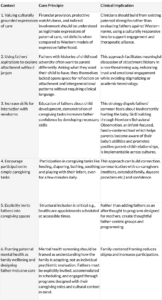
Supporting father engagement with infants utilizes the sociocultural entry points below (Table 1):
- Reframe financial provision, protective vigilance, and indirect involvement as meaningful expressions of paternal caregiving rather than deficits relative to Western norms.
- Leverage reflective capacity by inviting fathers’ narratives about their own childhood experiences and what they hope to emulate in their parenting while equipping them with practical caregiving skills, especially among those who experienced father absence and/or childhood adversity.
- Increase skills for interaction with newborns and dispel fears about inadvertently hurting the baby through community-based education of fathers about child development, demonstration of caregiving tasks and practical clinical tools that facilitate bonding e.g., Newborn Behavioral Observation (Nugent et al, 2007; Yago et al., 2023)
- Encourage participation in simple caregiving tasks like feeding, diapering, bathing, soothing and playing with their infant, even for a few minutes daily.
- Explicitly invite fathers into caregiving spaces. Structural inclusion is critical e.g., healthcare appointments scheduled at accessible times. Simply adding fathers as an afterthought to programs designed for mothers is ineffective. Evidence from rural India demonstrates that paternal participation increases substantially when programming is intentionally designed with men’s roles, schedules, and engagement styles in mind (Nair et al., 2020).
- Normalize paternal mental health needs and screening as part of family adjustment rather than individual psychopathology, to reduce stigma and enhance uptake.
Table 1. Sociocultural entry points for Father-infant engagement.
These clinical strategies leveraging sociocultural perspectives are most impactful and sustainable only when backed by robust governmental policy. Indeed, there may be lessons to learn across cultures as we discuss below.
Policy as Catalyst for Cultural Change
South Korea
South Korea offers an excellent example of how policy can act as a catalyst for cultural change and redefine fathering norms. As a result of a national demographic crisis marked by the world’s lowest fertility rate, South Korea transformed its paternity and parental leave policies through successive revisions to the Equal Employment Opportunity and Work–Family Balance Assistance Act (Kim, Byung-Cheol, et al 2025).
Prior to 2008, fathers had virtually no legal recognition as caregivers. Initial reforms introduced minimal unpaid leave, expanding gradually to five days, partly paid. A major shift occurred in 2019 with the introduction of 10 days of fully paid paternity leave, accompanied by broader recognition that incremental change was insufficient to counter deeply entrenched work-first culture (Kim, Yeon-Jin, 2022).
By 2025 and 2026, policy reforms doubled standard paternity leave to 20 days and allowed fathers to initiate leave up to 50 days before birth in cases of maternal medical complications. Fathers were also granted the flexibility to divide leave into multiple segments, reflecting the nonlinear needs of early childhood caregiving. These changes signaled a move from viewing fathers as auxiliary helpers toward a shared parenting model.
Utilization initially lagged behind legislation, constrained by workplace norms and hierarchical corporate structures. However, the introduction of financial incentives, including the “6+6 Parental Leave Scheme,” which provided full wage replacement for both parents during the first 18 months of a child’s life, markedly increased uptake. By 2025, men accounted for 36.8% of parental leave users, reflecting greater acceptability and possibly reduced stigma associated with leave-taking fathers (Republic of Korea Ministry of Employment and Labor, 2025; Huh, 2025).
Psychosocial benefits have been substantial. Fathers who take extended leave report increased parental self-efficacy and stronger emotional bonds with their infants (Noh, 2021). Maternal stress and postpartum depression risk decrease, household labor becomes more equitable, and marital satisfaction improves. Women’s career continuity is also better protected.
Challenges persist, particularly workplace alienation and fears of stalled career advancement, especially among older male supervisors (Lee & Moon,2025; Lee, et al. 2026). Nevertheless, developmental research suggests that children of leave-taking fathers demonstrate improved socioemotional regulation, cognitive flexibility, and parental warmth. South Korea illustrates how structural policy can catalyze cultural transformation, even in historically patriarchal contexts.
El Salvador
The history of civil war in El Salvador percolates to contemporary society as a result of mass displacement, widespread trauma, and the disruption of family systems (United Nations, 1992). Fathers were often forced into roles prioritizing survival and economic provision over emotional presence. Postwar challenges in the form of gang violence, migration, deportation, and transnational family arrangements further fragment caregiving structures. Many Salvadoran fathers work long hours, often 10–12 hours daily including commuting, limiting opportunities for engagement despite desire. Migration may improve financial stability while simultaneously introducing emotional distance and attachment disruptions for children left with extended families.
Traditionally, Latino fatherhood is often framed through the lens of machismo, characterized by emotional restraint and authority. However, the concept of caballerismo offers a more nuanced and strengths-based model, emphasizing responsibility, empathy, and commitment to family. Redefining masculinity to include emotional presence and collaboration fosters autonomy, emotional intelligence, and resilience in children and core cultural values such as familismo, respect, and prioritization of education further support paternal engagement.
Policy reform has been introduced to support father involvement in families. The 2022 “Nacer con Cariño” (“Born with Love”) law allows fathers to accompany mothers during pregnancy, birth, and postpartum care—an important shift from prior restrictions that excluded men from delivery rooms. This policy creates opportunities for early bonding and signals institutional validation of paternal presence (Pan American Health Organization, 2022).
Discussion
From the beginning of life, across diverse contexts, we find that children thrive when their fathers are emotionally engaged and involved. Contemporary societal shifts toward more fluid gender roles presents an opportunity to fortify family caregiving capacity by better engaging fathers especially in developing countries where much of the world’s growing child population is located.
Seen in the backdrop of broader social instability driven by globalization, political upheaval, technological transformation, and economic pressures, the critical question is whether we will regress toward authoritarianism or evolve into a more equitable society. We as child and adult psychiatrists, posit that strong father–infant relationships provides a stabilizing force that supports progress.
Two essential catalysts facilitate societal progress. Firstly, structural support from the government, such as state-sponsored parental leave, healthcare policies, and professional endorsement of father involvement are needed. Secondly, concordance with spiritual and cultural narratives such as the Confucian teacher, the faith-based storyteller, or the familismo-oriented Latino father may provide community sanction for father-infant emotional connection and caregiving.
Conclusion
Father involvement in early childhood is not a luxury or cultural artifact; it is a developmental necessity with universal relevance. While expressions of fathering vary across cultures, the foundational needs of children for safety, connection, and guidance remain constant. Clinically, recognizing structural constraints, leveraging sociocultural strengths, and explicitly inviting fathers into caregiving spaces enhances outcomes for children and families alike.
Supporting father engagement from conception through education, clinical practice, and policy creates healthier families, more resilient societies; it is an investment in future generations.
References
Bieleninik, Ł., Lutkiewicz, K., Jurek, P., & Bidzan, M. (2021). Paternal postpartum bonding and its predictors in the early postpartum period: A cross‑sectional study in a Polish cohort. Frontiers in Psychology, 12, 628650. https://doi.org/10.3389/fpsyg.2021.628650
Cameron, E. E., Sedov, I. D., & Tomfohr-Madsen, L. M. (2016). Prevalence of paternal depression in the early postnatal period: A meta-analysis. Journal of Affective Disorders, 203, 13–20. https://doi.org/10.1016/j.jad.2016.05.073
Deneault, A.-A., Tarraf, A., Bordeleau, C., Gariépy, M., Myre, G., Gagné, A., Beaulieu, L., & Racine, N. (2026). How fathers seek to break the intergenerational transmission of ACEs: A qualitative study of Canadian fathers. Child Protection and Practice, 8, 100291. https://doi.org/10.1016/j.chipro.2026.100291
Huh, M. (2025). Korea. In I. Dobrotić, S. Blum, G. Kaufman, A. Koslowski, P. Moss, & M. Valentova (Eds.), International review of leave policies and research 2025. Leave Policies and Research Network. https://www.leavenetwork.org/annual-review-reports/
Husain, N., Kiran, T., Shah, S., Rahman, R., & Tomenson, B. (2025). Paternal perinatal depression in low- and middle-income countries: Prevalence, correlates, and implications for child development. World Psychiatry, 24(1), 45–56.
Kim, B.-C., et al. (2025). Declining fertility rates and stratified reproduction among women in East Asia: What can we learn from the cases of China, Japan and South Korea? Journal of Asian Public Policy, 18, 1–15.
Kim, Y.-J. (2022). Korean fatherhood in policy and practice. Lund University.
Lee, H., & Moon, W. (2025). The parenting reality gap: Men’s rationalization and women’s conformity in Korea. Family Relations, 74(5), 2664–2681.
Lee, Y., Park, S.,Kim, J., Kim, E.,. (2026). Perceptions of fairness in gender relations: A qualitative study of South Korean middle-aged men. International Journal of Qualitative Studies on Health and Well-Being, 21(1), 2637803.
Lobo, E., Krishnan, R., & Rao, P. (2025). Fathers, caregiving, and masculinity in urban India: A qualitative study from Bangalore. Culture, Medicine, and Psychiatry, 49(1), 112–130.
McLanahan, S., Tach, L., & Schneider, D. (2013). The Causal Effects of Father Absence. Annual Review of Sociology, 39, 399–427.
Mithra, P., Rekha, T., Nair, S., & Unnikrishnan, B. (2021). Fathers’ involvement in infant feeding practices in coastal South India: A mixed-methods study. Journal of Family Studies, 27(3), 345–359. https://doi.org/10.1080/13229400.2020.1755954
Nair, S., Tripathy, P., Sachdev, H. S., Pradhan, H., Gope, R., Gagrai, S., Rath, S., Rath, S., Bajpai, A., & Costello, A. (2020). Effect of participatory women’s and men’s groups on father involvement in childcare in rural Tamil Nadu: A community-based intervention. BMC Public Health, 20, Article 1214. https://doi.org/10.1186/s12889-020-09323-7
Noh, N. I. (2021). First-time fathers’ experiences during their transition to parenthood: A study of Korean fathers. Child Health Nursing Research, 27(3), 286.
Nugent, J. K., Keefer, C.H. , Minear. S., Johnson, L.C., Blanchard,Y. (2007). The Newborn Behavioral Observations (NBO) System Manual. Cambridge, MA: Brazelton Institute.
Pan American Health Organization. (2022). OPS participante de la Ley Nacer con Cariño (PAHO/WHO Bulletin No. 3). https://www.paho.org/sites/default/files/2022-07/boletin-ops-els-marzo2022.pdf
Pleck, J. H. (2010). Fatherhood and masculinity. In M. E. Lamb (Ed.), The role of the father in child development (5th ed., pp. 27–57). Wiley.
Ramchandani, P. G., Stein, A., Evans, J., & O’Connor, T. G. (2013). Paternal depression in the postnatal period and child development: A prospective population study. The Lancet, 365(9478), 2201–2205. https://doi.org/10.1016/S0140-6736(05)66778-5
Republic of Korea Ministry of Employment and Labor. (2025, October 28). One in three parental leave recipients in Korea are fathers. https://biz.chosun.com/en/en-society/2025/10/28/5JQ7SOHCJ5BZ7NDMCVZZKT4JLQ/
Rodrigues, M., Sokolovic, N., Madigan, S., Luo, Y., Silva, V., Misra, S., & Jenkins, J. M. (2021). Paternal sensitivity and child development: A meta-analysis. Developmental Review, 60, 100970. https://doi.org/10.1016/j.dr.2021.100970
Sarkadi, A., Kristiansson, R., Oberklaid, F., & Bremberg, S. (2008). Fathers’ involvement and children’s developmental outcomes: A systematic review of longitudinal studies. Acta Paediatrica, 97(2), 153–158. https://doi.org/10.1111/j.1651-2227.2007.00572.x
Sethna, V., Murray, L., Netsi, E., Psychogiou, L., & Ramchandani, P. G. (2017). Paternal depression in the postnatal period and early father–infant interactions. Infant Mental Health Journal, 38(3), 370–383. https://doi.org/10.1002/imhj.21629
Shorey, S., & Ang, E. (2019). The role of paternal involvement in infant and child outcomes: A systematic review. Journal of Advanced Nursing, 75(2), 240–257.
Siegel, D. J., & Bryson, T. P. (2012). The whole-brain child: 12 revolutionary strategies to nurture your child’s developing mind. Bantam Books.
United Nations. Report on Human Rights Violations in El Salvador During the Civil War. New York, NY: UN Human Rights Office; 1992.
Yago S, Takahashi Y, Tsukamoto E, Saito A, Saito E. Use of the Newborn Behavioral Observations System as an early intervention for infants and their parents: A scoping review. Early Hum Dev. 2023;183:105811. doi: 10.1016/j.earlhumdev.2023.105811. Epub 2023 Jun 19. PMID: 37385114.
Yogman, M., Garfield, C. F., & Committee on Psychosocial Aspects of Child and Family Health (2016). Fathers’ Roles in the Care and Development of Their Children. Pediatrics, 138(1), e20161128.
Authors
Bala, Abishek, MD
Department of Psychiatry, Central Michigan University,
Saginaw, Michigan, United States
Marquez-Castro, Henry, MD
Department of Psychiatry, University of California - San Diego,
San Diego, California, United States
Lee, Joo-Young, MD, MS
Department of Psychiatry, University of Colorado School of Medicine,
Aurora, Colorado, United States
Zeshan, Muhammad, MD
Department of Psychiatry, Rutgers New Jersey Medical School,
Newark, New Jersey, United States
Harrison, Alexandra, MD
Division of Child Psychiatry, Cambridge Health Alliance/ Harvard Medical School,
Boston, Massachusetts, United States
Shaligram, Deepika, MD
Department of Psychiatry, Boston Children’s Hospital/Harvard Medical School,
Boston, Massachusetts, United States
Funding: The authors received no funding for this article.
Disclosures: The authors have no biomedical financial interests or potential conflicts of interest.
Corresponding author: Deepika Shaligram, MD, deepika.shaligram@childrens.harvard.edu