Abstract
Objective: Infant Mental Health (IMH) refers to an infant’s developing capacity to experience and express their emotions, form close and secure relationships, and explore their environment within the caregiving context. Early relationships are fundamental to IMH. Hospitalisation and illness provide barriers and challenges to these early relationships. This study explored staff and parent perspectives on hospital-based infant care during paediatric admissions.
Methods: A mixed-methods survey was conducted across four hospital sites of a paediatric hospital. Parents and staff completed anonymous questionnaires including Likert scale items and open-ended questions. Quantitative data are presented descriptively; qualitative data were analysed using reflexive thematic analysis.
Results: Thirteen parents and fifty six staff participated. Parents emphasised the importance of bonding opportunities, emotional and practical support. Staff highlighted frameworks to implement IMH and developmental care, prioritising parents as primary caregivers and addressing environmental and systemic barriers. Shared findings underscored the importance of family-centred care.
Conclusion: Embedding IMH practices within paediatric hospitals supports parent-infant relationships and infant development. Organisational policies, staff training and environmental improvements are needed to sustain consistent IMH-aligned care.
Keywords: infant mental health, developmental care, paediatric, parent-infant relationships
Introduction
The first 1001 days of a baby’s life, from conception to age two, lay the foundations for relational, cognitive, emotional and social development (Centre on the Developing Child, 2017). Babies’ brains are shaped by the world around them and their experiences, through interactions with their caregivers (Bowlby, 1969). Early responsive and attuned caregiving provide scaffolding for secure attachment and development of affect regulation (Ainsworth et al., 1978; Schore, 2001). Infant and Early Childhood Mental Health (IECMH) is “defined as developing the capacity of the infant and young child to form close and secure relationships; to experience, manage, and express a full range of emotions; and explore the environment and learn – all in the context of family, community, and culture” (Zero to three, 2023).
Caring for vulnerable infants in hospital brings additional stressors in unfamiliar environments to parents and infants, such as disempowerment of parents, painful procedures, medical interventions and psychosocial challenges. These disruptions can heighten infant stress responses and challenge parent infant bonding (Wigert, Johnson & Hellström, 2013). In turn, stressful early experiences are associated with later emotional, cognitive and behavioural difficulties (Shonkoff & Garner, 2012). Supporting IECMH, and IMH in those early weeks and months of a baby’s life in hospital, can help mitigate these challenges to reduce negative social, emotional and neurodevelopmental outcomes.
While optimising care of infants in NICU (Dressler, 2024; Serlachius et al., 2018), prioritising care of children across age categories in Paediatric Intensive Care Unit (PICU) (Ammentrop, Mainz & Sabroe, 2005), and shared perceptions of staff and parent perspectives in NICU (Pritchard & Montgomery-Honger, 2014) is well established, specific focus on IMH in paediatric settings is less explored. Less is also known about implementation of IMH and developmental care models from NICU in paediatric settings. Understanding the perspectives of both staff and parents of infant care in paediatric hospital is essential for guiding and promoting IMH-aligned practices and strengthening parent-infant relationships in hospital. These perspectives importantly help inform, prioritise and strengthen IMH practices, which ideally would be sustained over time (Weaver et al., 2022). This paper explores staff and parent perspectives of infant care during paediatric hospital admissions.
Method
Design
A mixed-methods, cross-sectional survey was conducted across four paediatric hospital sites.
Ethics
Ethics approval was obtained from the CHI Research Ethics Committee. Participation was voluntary and anonymous.
Questionnaire
The survey included Likert-scale items (5-point scale) and open-ended questions exploring knowledge, practices, experiences and suggestions to improve IMH. Items were informed by a literature review and scoping review of current measures. Survey items underwent team review by authors, with blind inter-rater reliability on survey development. Pilot testing was conducted with staff and parents.
Recruitment and Procedure
Questionnaires were distributed via QR codes, secure links and paper copies between May and September 2023. Eligible participants were parents over 18, with an infant in hospital ≥2 weeks and staff working with infants.
Data Analysis
Quantitative data were summarised descriptively. Qualitative data were analysed using reflexive thematic analysis (Braun & Clarke, 2006). Parent and staff data were analysed and presented separately.
Results
Participants
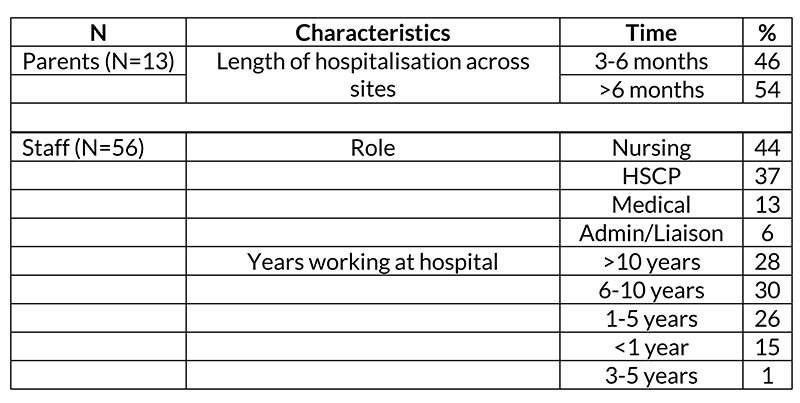
Thirteen parents and fifty six staff completed the survey (Table 1).
Table 1. Descriptive statistics for staff and parent characteristics.
Qualitative Parent Findings
Inductive thematic analysis generated two interrelated themes.
Theme 1: Facilitating Parent-Infant Bonding: “Helping me be a parent”
Parents were united in finding ways to meaningfully connect and bond while caring for their fragile, sick or premature infants in paediatric hospitals. Subthemes describe how parent-infant bonding was facilitated to help parents feel less helpless in times of medical uncertainty and less detached from infants due to tubes, wires and being in a potentially overwhelming environment.
1.1 Physical Closeness and Developmental Supportive Participation in Care
Parents reported valuing staff encouragement in supporting developmental interactions with infant care such as skin to skin, holding and positive touch like “hand hugs” for more vulnerable infants. Parents reported that staff encouragement to feed, cuddle, read, sing and even change their baby, emphasised parental roles, strengthened bonding and fostered a sense of control with the helpless feelings of having a sick infant in hospital.
Theme 2: Reducing Parental Stress Through Emotional and Practical Support: “They are always very re-assuring”
Parents noted conflicting communication of treatment plans, environmental constraints, high workloads of staff, separation from infants and the need for wider support for families can elevate caregiver stress. Parents also reported emotional and practical support from staff helped reduce distress and promotes wellbeing. Staff provided essential scaffolding to enhance parental confidence in their caregiving capabilities with a fragile infant, while also encouraging parental self-care.
2.1 Kindness and Emotional Support
Parents mainly described staff as kind, empathic, personable and reassuring. Feeling listened to reduced anxiety, helped parents cope better, manage new procedures while remaining emotionally available to their infants.
2.2 Guidance and Confidence Building
Parents valued the tailored, hands-on support with feeding and handling infants. Mastering procedures to feel relaxed when caring for infants featured in parental narratives.
2.3 Encourage Parental Self-Care
With the stress and care vulnerable infants need in hospital, parents valued prompts to eat, sleep and look after themselves. These punctuations supported emotional regulation and improved capacity to care for infants.
Qualitative Staff Findings
Inductive thematic analysis of fifty six staff participants generated three overarching themes.
Theme 1. IMH and Developmental Care
This first theme captured staff understandings of definitions of IMH and developmental care to assess the level of shared organisational language and terminology when reviewing infants.
1.1 Conceptualising IMH and Developmental Care
Most staff described IMH as emotional and relational: “IMH means the baby’s unfolding emotional and social development being supported to attain their potential within the parent infant relationship and contexts within which they are developing”.
Definitions of developmental care varied. Over a third of staff referred to developmental care as ages and stages of developmental milestones, while others viewed developmental care with cues, sensory regulation, therapeutic handling, limiting stress during procedures, environmental support, relational care and play based interventions, highlighting a need for shared language.
1.2 Physical and Comfort Focussed Care
Staff highlighted the need for physical care including anticipating the care needed for interventions, pain relief during dressings, feeding support and safe handling, positioning and minimising distress. Non-pharmacological comfort strategies were viewed as essential to support infants to manage procedures.
1.3 Sensory and Environmental Regulation
Staff emphasised reducing noise and overstimulation, clustering care and maintaining appropriate day-night cycles to support low stress, developmentally appropriate environments for infants.
1.4 Relational and Communicative Practices
Staff identified rich relational practices in handling of infants as the optimal foundation for IMH. Infant-directed speech, talking through procedures, keeping the baby in mind, singing to the baby, parental involvement to comfort and relational presence during interventions were common practices.
1.5 Indirect Infant Care “Closeness to parents should be prioritised at all times”
Parents were viewed as primary caregivers. Staff noted the positive impact of providing time and education for parents to be involved in care such as feeding with nasogastric tubes, bonding opportunities and education on infant cues of vulnerable babies where a baby’s behaviour may be more difficult to understand. Although not yet standard practice, staff also encouraged parents to participate in ward rounds to help them have a sense of agency and control as parents. Involving parents enhanced agency and closeness.
Theme 2: Staff as Collaborators in Care of Infants “I feel privileged to work with babies and parents, being in a position of trust at such a sensitive time.”
This theme was conceptualised as a deep commitment from caring, well trained staff who are dedicated to their roles, with infant centred care at the heart of the commitment.
2.1 Emotional Meaning of Working with Infants
Across roles, staff described working with infants as “meaningful, fulfilling, a privilege, and rewarding”. Many expressed pride in observing developmental progress, supporting whole families during vulnerable times and contributing to early relational health between caregivers and infants. This reflected both a sense of responsibility and emotional investment “It’s a special job to be able to look after sick babies…to support families through their hardest times”.
Alongside these positive sentiments, staff identified and acknowledged the emotionally complex landscape of work. They described the dual experience oscillating between positive experiences of joy and sadness, balancing developmental progress with the realities of illness, invasive procedures and organisational constraints.
A small number of early career staff, reported apprehension with vulnerable infants due to a limited understanding of infants’ non-verbal communication and cues. Supportive team members, shared learning and collaborative ward cultures lessened these challenges.
Overall, staff conveyed a deep emotional investment with parent and infant care and a strong sense of meaning with their roles with one staff member remarking it’s the “Best job in the world, I absolutely adore it”.
2.2 Multidisciplinary Team (MDT) Collaboration
Participants identified MDT as central to service delivery. Staff highlighted the unique contribution of play specialism and music therapy to infants, alongside medical, nursing and allied health professionals. Staff also highlighted the positive impact of CHI resources and campaigns within the hospital to keep embedding IMH practices such as ‘The Story of Me’ (Neonatology CNSp, 2021) and the ‘My Little Voice’ booklet (Cunningham, Cotter & McElroy, 2022).
Theme 3: Service Needs and Barriers “Don’t think we have the time to support the baby or families the way we would like”
IMH should be embedded as a core organisational value as infants in paediatric care need specialised clinical care and family support to optimise IMH implementation.
3.1 Workloads and Time Constraints
A common barrier was insufficient time due to staffing shortages and high acuity of clinical demands which can limit opportunities for relational and developmental care. Nurses reported significant task burden and suggested expanding roles including lactation specialists and IMH champions to alleviate pressure and positively contribute to infant needs.
3.2 Service Level Gaps
Acute medical demands can overshadow developmental and IMH priorities. Limited access to psychology, social work, and specialist training to develop competencies were identified. Staff acknowledged peer support from colleagues and advocated for reflective supervision, debriefing after critical incidents, structured perinatal mental health and IMH pathways, and clearer policies to ensure consistency of care across services.
Despite strong individual commitment and strong team-based support, systemic pressures in staffing, resources, training, and organisational structures presented challenges to staff in delivering optimal IMH for families.
Discussion
Summary
Parents and staff acknowledged hospitalisation as stressful for infants and families. Both groups emphasised the importance of parental involvement to enhance parent and infant wellbeing.
Parents perceived staff as largely committed, caring, knowledgeable, valuing reassurance and encouragement. Staff prioritised parents as primary caregivers and demonstrated commitment to IMH, developmental care and family integrated care frameworks (e.g. O’Brien et al., 2018).
Staff shared an understanding of IMH frameworks and practices. However, variability in understanding developmental care indicated a need for ongoing education and training.
Systemic pressures including staff shortages, time constraints and inconsistent communication affected care delivery. Staff and parents advocated for zero-separation and involvement of extended families, e.g. grandparents in support roles, to keep parents and infants together. Staff endorsed developing family friendly spaces and parents poignantly identified outdoor spaces as a means to reduce the medicalisation of the environment “I would love to be able to spend a few minutes outdoors with my baby every day…to see the sky or feel the sun”.
Implications
At a broad systems level, opportunities for growth included the development and establishment of a formal IMH network with champions, keyworkers, ongoing education, webinars, reflective supervision and IMH pathways for integrating IMH across multiple teams and hospital services. Within an IMH charter, organisational policies and guidelines, quality initiatives and infrastructure are critical to sustain optimal and consistent IMH practices, from admission to discharge, beyond individual staff efforts. Embedding policies such as zero separation and improving environmental spaces to allow for parents to room-in with infants, reduction of noise, improved access to breastfeeding support were endorsed by staff and parents. These initiatives align with evidence that physical closeness buffers stress and supports long term development of infants.
This study highlights opportunities for hospital wide education and training on evidence based tools to strengthen relationships between infants and parents in the newborn period. Strengths based tools, such as the Newborn Behavioural Observation (NBO; Nugent, Keefer, Minear, Johnson & Blanchard, 2007) could help improve the quality of early experiences at a critical transition in parent infant relationships in hospitals. These tools have a secondary benefit of developing a shared language, a collective theoretical understanding and inform cultural and systemic change to ensure shared understandings of the needs of parents and infants in hospital.
Conclusion
“One of the greatest gifts we can give to others is the gift of attention and presence. In the realm of infant mental health, it is through our relationships that we heal and grow.”
T. Berry Brazelton
This study highlighted important strengths on the centrality of compassion and staff collaboration with parents and infants during paediatric admissions. Staff and parents were united in underscoring the need “to keep the baby in mind” by embedding IMH and developmental care practices into policies, training and hospital culture. Sustained commitment to centring parent-infant voices ensures relationship-based, IMH and developmentally informed hospital care for infants and families.
Acknowledgments
We thank parents and staff who generously contributed their time and insights. We are grateful to Catherine Cunningham and colleagues in the wider CHI Infant Mental Health Network, and the continued support and collaboration with Dr Kevin Nugent and Dr Lise Johnson (Brazelton Institute) and Inge Nickell (Brazelton Centre, UK).
References
Ainsworth, M. D. S., Blehar, M., Waters, E., & Wall, S. (1978). Patterns of attachment: psychological study of the strange situation. Lawrence Erlbaum.
Ammentorp J, Mainz J, Sabroe S. Parents’ Priorities and Satisfaction With Acute Pediatric Care. Arch Pediatr Adolesc Med. 2005;159(2):127–131. https://doi:10.1001/archpedi.159.2.127
Bowlby, J. (1969). Attachment and loss: Vol. 1. Attachment (2nd ed.). Basic Books.
Braun, V., & Clarke, V. (2006). Using thematic analysis in psychology. Qualitative Research in Psychology, 3, 77–101.
Center on the Developing Child. (2017). Three principles to improve outcomes for children and families. Harvard University.
Cunningham, C, Cotter, C. & McClory, E. (2022). My Little Voice: the messages your baby is communicating with you. Speech and Language Therapy Department, Children’s Health Ireland.
Dressler, C. (2024). The psychological implications of having an infant in the NICU for mothers and fathers. Journal of Neonatal Nursing, 30(5), 468-469. https://doi.org/10.1016/j.jnn.2024.01.005.
Nugent, J. K., Keefer, C. H., Minear, S., Johnson, L. C., & Blanchard, Y. (2007). Understanding newborn behavior and early relationships: The Newborn Behavioral Observations (NBO) system handbook. Paul H. Brookes Publishing Co..
Neonatology Clinical Nurse Specialists, CNSp, (2021). The Story of Me. Children’s Health Foundation (CHF), Children’s Health Ireland (CHI).
O’Brien, K., Robson, K., Bracht, M., Cruz, M., Lui, K., Alvaro, R., da Silva, O., Monterrosa, L., Narvey, M., Ng, E., Soraisham, A., Ye, X. Y., Mirea, L., Tarnow-Mordi, W., Lee, S. K., & FICare Study Group and FICare Parent Advisory Board (2018). Effectiveness of Family Integrated Care in neonatal intensive care units on infant and parent outcomes: a multicentre, multinational, cluster-randomised controlled trial. The Lancet. Child & adolescent health, 2(4), 245–254. https://doi.org/10.1016/S2352-4642(18)30039-7
Pritchard, V. E., & Montgomery-Hönger, A. (2014). A comparison of parent and staff perceptions of setting-specific and everyday stressors encountered by parents with very preterm infants experiencing neonatal intensive care. Early Human Development, 90(10), 549–555. https://doi.org/10.1016/j.earlhumdev.2014.07.006
Shonkoff, J. P. & Garner, A. S., Committee on Psychosocial Aspects of Child and Family Health, Committee on Early Childhood, Adoption, and Dependent Care, & Section on Developmental and Behavioral Pediatrics (2012). The lifelong effects of early childhood adversity and toxic stress. Pediatrics, 129(1), e232–e246. https://doi.org/10.1542/peds.2011-2663
Serlachius, A., Hames, J., Juth, V., Garton, D., Rowley, S., & Petrie, K. J. (2018). Parental experiences of family-centred care from admission to discharge in the neonatal intensive care unit. Journal of paediatrics and child health, 54(11), 1227–1233. https://doi.org/10.1111/jpc.14063
Schore, A. N. (2001). Effects of a secure attachment on right brain development. Infant Mental Health Journal, 22(1–2), 7–66. https://doi.org/10.1002/1097-0355(200101/04)22:1<7::AID-IMHJ2>3.0.CO;2-N
Weaver, A., Dawson, A., Murphy, F., Phang, F., Turner, F., McDadyen, A. & Minnis, H. (2022). Prioritising Infant Mental Health: A Qualitative Study Examining Perceived Barriers and Enablers to Infant Mental Health Service Development in Scotland. Perspectives in Infant Mental Health, 30(1), pp. 21-28. https://doi.org/10.1108/JMHTEP-02-2023-0016
Wigert, H., Johansson, R., Berg, M., & Hellström, A. (2013). Mothers’ experiences of their contact with the child when the infant is cared for in a neonatal unit. Journal of Neonatal Nursing, 19(3), 134–142. https://doi.org/10.1111/j.1471-6712.2006.00377.x
Zero to Three. (2023). Zero to Three’s infant and early childhood mental health (IECMH) guiding principles. https://www.zerotothree.org/resource/resource/zero-to-threes-infant-and-early-childhood-mental-health-iecmh-guiding-principles/
Authors
Dr Casey, Anne-Marie
Senior Clinical Psychologist in Neonatology and Infant Mental Health Specialist, IMH-E®,
Paediatric Psychology Department, Children's Health Ireland (CHI) at Crumlin Hospital,
Dublin, Ireland
annemarie.casey@childrenshealthireland.ie
Dr Coey, Philip
Senior Clinical Psychologist in Neurology,
Paediatric Psychology Department, CHI at Crumlin Hospital,
Dublin, Ireland
Dunne, Jenny
Clinical Nurse Manager III in Neonatology,
CHI at Crumlin and Temple Street Hospitals,
Dublin, Ireland
McKay, Ciara
Senior Speech & Language Therapist in Neonatology & Internationally Board Certified Lactation Consultant (IBCLC),
CHI at Temple Street Hospital,
Dublin, Ireland
Dr Twohig, Aoife
Consultant Psychiatrist with a Special Interest in Infant and Early Childhood Mental Health,
CHI at Temple Street Hospital,
Dublin, Ireland
McMahon, Ciara
Research Assistant,
Department of Psychology, Maynooth University,
Ireland
McHugh Power, Joanna, PhD
Associate Professor in Psychology,
Department of Psychology, Maynooth University,
Ireland