Introduction
The United Nations Convention on the Rights of the Child, the most widely ratified human rights treaty, states that every newborn baby has the right to equality, freedom from discrimination, and equitable care (United Nations, 1989). We propose that human rights guarantees for newborns and their families can be put into practice as part of high-quality healthcare through the use of the Newborn Behavioral Observations (NBO) system (Nugent, Keefer, Minear, Johnson & Blanchard, 2007). The NBO is an evidence-based clinical tool that supports perinatal mental health, early parenting, and infant development by helping parents see and respond to their infant’s communication, capacities and vulnerabilities. In underscoring the infant’s personhood and relational agency from the moment of birth, the NBO is also an act of human rights advocacy, affirming the newborn’s rights to dignity and respect and to be an active participant in their family, community and culture.
The United Nations Convention of the Rights of the Child
The UN Convention on the Rights of the Child (UNCRC) recognizes the fundamental human dignity and rights of all children and the urgency of ensuring their well-being and development (United Nations, 1989). The UNCRC emphasizes the provision of supports and guarantees to families from birth onwards.
The World Association for Infant Mental Health (WAIMH) fully endorses the UNCRC, and the subsequent General Comment Number 7 (United Nations, 2005), to strengthen understanding and implementation of children’s rights in early childhood. The WAIMH Position Paper on the Rights of Infants contends that there are unique considerations regarding the needs of infants from birth through the first three years of life, underscored by the impact of early relational experience on the development of the human brain and mind and on life-long health outcomes (Shonkoff, Boyce, & McEwen, 2009; WAIMH Position Paper on the Rights of Infants, 2016). The Diversity-Informed Tenets for Work with Infants, Children and Families further call upon clinicians to champion children’s rights globally, to acknowledge privilege and combat discrimination, to recognize and respect nondominant bodies of knowledge, honor diverse family structures, allocate resources to systems change, open pathways for the marginalized, and advance equitable policies for families (Thomas, Noroña & St. John, 2019).
Translation of these rights into practice is a prerequisite for high-quality newborn healthcare around the world – in health facilities and at home. Access to high-quality universal health care is the right of every newborn, and although suboptimal care still impedes desired health outcomes in many parts of the world, as neonatal mortality decreases, global agendas are expanding their focus from survival to care that optimizes neurodevelopmental outcomes (Kuruvilla et al., 2016; Wojcieszek et al. 2023).
High Quality Care and the Promotion of Human Rights in the Newborn Period
Newborn behavior and development and human rights are usually discussed as separate fields, but we are proposing that human rights should be at the core of clinical work with newborns and their families. High quality newborn care involves more than addressing biological needs, it requires attunement and responsiveness to the infant’s emotional and relational signals to support their wellbeing and development, even in lifesaving intensive care settings. This demands respect for the infant as protagonist in their life, with the right to be listened and responded to, not just assessed, treated and talked about.
Within the first 1000 days of life, the first 100 days of life may be the touchpoint par excellence in promoting the infant’s health and human rights. This period consists of a series of survival and adaptive challenges for the infant and the emerging parent–child relationship, the resolution of which constitutes the foundation of the child’s developmental outcome (Als,1982; Brazelton, 2009; Bruschweiler-Stern, 2009; Porges, 2015; Trevarthen, 2003). During this particularly significant period there is unparalleled/major brain growth, maturation and transformation in many neural functions, supporting the infant’s behavioural adaptation to their environment and early relationship formation with their caregivers. All this offers great opportunity for interventions to impact the life trajectory (Barlow et al. 2011; Feldman, Bamberger, and Kanat-Maymon, 2013; Mayes, Rutherford, Suchman and Close, 2012; Reddy & Trevarthen, 2004; Sadler et al. 2002; Tottenham, 2020; Tronick, 2007).
The use of the NBO in affirming the baby’s human rights
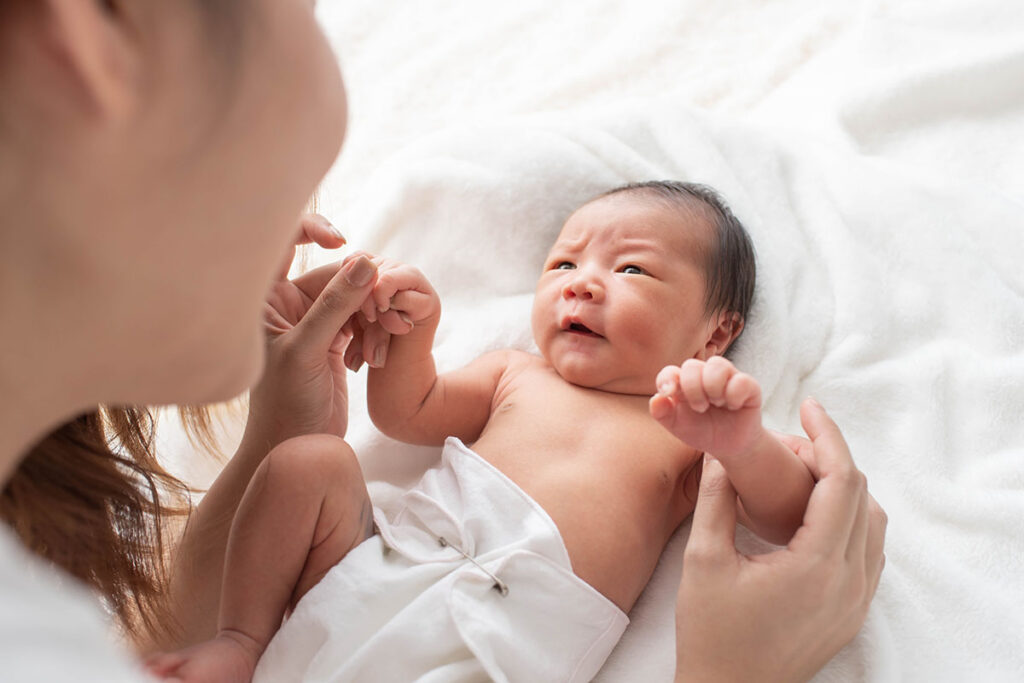
The newborn period provides the parents, the family and the community with a unique opportunity to see, hold, touch, and engage with their baby. At this pivotal time, the NBO – a clinical tool, designed for use in the first three months of life – allows practitioners to learn with parents about their child’s communication strategies and overall development and allows the baby the space to show through their behavior who they are, and what relational support and connection they seek, need, and value.
The NBO system consists of 18 neurobehavioral observations, addressing sleep protection, crying and consoling, motor tone and reflexes, response to the visual and auditory stimuli, and stress tolerance. During a session, the newborn may demonstrate a wide range of visual, auditory, and perceptual abilities that enable them to explore the world around them and connect with their caregivers, engaging in face-to-face, eye-to-eye mutual exchange (Brazelton, 2009; Trevarthen 2003). Self-regulatory challenges and strategies are observed and supported throughout.
With the NBO, newborn health care and human rights advocacy are integrated: the baby’s voice is respected and amplified through observation. The practitioner respectfully joins the parent and together they meet with baby and explore the infant’s capacities and vulnerabilities; the baby’s agency and right to participate are affirmed; and parents are supported to see and accept their newborn’s experiences and caregiving needs in real-time, in other words, to see the baby as a person and to see themselves in relationship with this person. Parents begin to learn from the baby how they can support their wellbeing and their overall development and advocate for their rights. Moreover, the flexibility of the NBO allows for its use in multiple settings – hospital, outpatient office or clinic, or home, with nuclear family, extended family, kin and important community members’ participation. By design, the NBO welcomes all, serving as a vehicle for the newborn to “speak” to and connect with their community.
While the NBO reveals and respects the unique personhood of the baby, it also asserts that the consequent responsive caregiving that will best support the child’s entry into their society, be it collectivist or individualist, belongs in the hands of the parents and caregiving circle. Affirming the importance of traditions and cultural values for the protection and harmonious development of the child, the NBO is explicitly designed to be useful across different cultural contexts and acknowledges the centrality of kinship, connection, and social responsibilities for wellbeing in Indigenous communities (Spicer, Korfmacher, Sarche, 2024). These are important facets of how the NBO embodies human rights advocacy.
In sum, the NBO can be used within newborn health care to formally recognize and confirm the child’s personhood, celebrate their entry into the community and their right to live an individual life in society, to be brought up in the spirit of peace, dignity, tolerance, freedom, equality and solidarity, as articulated by the United Nations Convention. In practising the NBO, multi-disciplinary professionals model an attitude of respect, attention and advocacy for even the youngest and most vulnerable humans. This helps to shift societal norms, ensure infant rights are recognised early, and empower families and communities to protect and nurture those rights.
Research with the NBO
A series of randomized studies have demonstrated the effectiveness of the NBO in influencing the parent-infant relationship (Tazza, Ioverno & Pallini, 2023; Yago, Takahashi, Tsukamoto, Saito and Saito, 2023). Involvement in the NBO results in enhanced mother–infant engagement (McManus and Nugent, 2011, 2012; Nugent, Dym-Bartlett, Vonende and Valim, 2017), higher sensitivity and non-intrusiveness and reduction of anxiety symptoms in distressed mothers (Nicolson, Carron and Paul, 2022), fewer maternal depressive symptoms (McManus, Blanchard, Murphy & Nugent, 2020; Nugent, Dym-Bartlett and Valim, 2014), greater gains in cognitive and adaptive function at 6-months (McManus et al. 2020), parent’s greater understanding of their infant’s communication cues and their ability to establish a relationship with the infant (Høifødt et al. 2020; Kristensen, Juul and Kronborg, 2020), and higher maternal confidence and increased knowledge about their infant (Valla, Slinning, Wentzel-Larsen, Røsand & Arnardóttir, 2025).
It must be acknowledged that, while the NBO is widely used around the world and has been found to positively influence the parent-infant relationship in a range of cultural settings, most NBO research hitherto has been conducted in higher socio-economic countries, with under-representation of minority ethnicities and cultures among the study participants. Further, research to date has focused on the parent-infant relationship in a nuclear one-parent or two-parent context – occasionally including siblings or grandparents. The impact and value of conducting an NBO in Majority World study populations and of involving the child’s extended family, kinship group and community need to be better understood.
Conclusions
The field of infant mental health has increasingly turned its attention to questions of justice (Keren, Abdallah & Tyano, 2019; Spicer, Korfmacher, Sarche, 2024; WAIMH Position Paper on the Rights of Infants, 2016; Zeanah, Steier, Lim, Korfmacher & Zeanah, 2023). However, if we define our commitment to human rights and justice too abstractly, we will fail to specify how to meet that commitment. The NBO answers this call with its focus on engaging in real time in a relationship with the newborn as a competent and communicative person. We believe that how newborns are treated affects not just their lives but also the lives of their parents and family, the entire community, and indeed the health and well-being of the whole culture.
References
Als, H. (1982). ‘Toward a Synactive Theory of Development: Promise for the Assessment and Support of Infant Individuality’, Infant Mental Health Journal, 3: 229–43.
Barlow, J., Smailagic, N., Bennett, C., Huband, N., Jones, H., & Coren, E. (2011). Individual and group based parenting programmes for improving psychosocial outcomes for teenage parents and their children. The Cochrane database of systematic reviews, 2011(3), CD002964. https://doi.org/10.1002/14651858.CD002964.pub2
Bruschweiler-Stern, N. (2009). Moments of Meeting: Pivotal Moments in Mother, Infant, Father Bonding. In J. K. Nugent, B. J. Petrauskas, and T. B. Brazelton (eds.) The Newborn as a Person: Enabling Healthy Infant Development Worldwide, pp. 70–84. Hoboken: John Wiley and Sons.
Brazelton, T. B. (2009). The Neonatal Behavioral Assessment Scale (NBAS). In J. K. Nugent, B. J. Petrauskas, and T. B. Brazelton (eds.) The Newborn as a Person: Enabling Healthy Infant Development Worldwide, pp. 278–86. Hoboken: John Wiley and Sons.
Committee on the Rights of the Child (2015). “Committee on the Rights of the Child.” Retrieved 06/07/2015, from http://www.ohchr.org/EN/HRBodies/CRC/Pages/CRCIndex.aspx.
Feldman, R., Bamberger, E., and Kanat-Maymon, Y. (2013). Parent-Specific Reciprocity from Infancy to Adolescence Shapes Children’s Social Competence and Dialogical Skills. Attachment and Human Development, 15(4): 407–23.
Høifødt, R.S., Nordahl, D., Landsem, I.P. et al. (2020). Newborn Behavioral Observation, maternal stress, depressive symptoms and the mother-infant relationship: results from the Northern Babies Longitudinal Study (NorBaby). BMC Psychiatry 20, 300 (2020). https://doi.org/10.1186/s12888-020-02669-y
Johnson, L.C., Bartlett, J.D., Nugent, J.K. (2023). Gravens by Design: The Newborn Behavioral Observations system to support early parent-infant relationships in the NICU. Neonatology Today, 18, 9, 77-82.
Johnson, L. C., McManus, B., Blanchard, Y., & Nugent, J. K. (2025). The newborn behavioural observations system: A relationship-building intervention to support families in the neonatal intensive care unit. Acta Paediatrica (Oslo, Norway : 1992), 114(4), 752–759. https://doi.org/10.1111/apa.17314
Keren, M., Abdallah, G., & Tyano, S. (2019). WAIMH position paper: Infants’ rights in wartime. Infant Mental Health Journal, 40, 763–767.
Kristensen, I. H., Juul, S., & Kronborg, H. (2020). What are the effects of supporting early parenting by newborn behavioral observations (NBO)? A cluster randomised trial. BMC Psychology, 8(1), 107. https://doi.org/10.1186/s40359-020-00467-5
Kristensen, I. H., Vinter, M., Nickell, I. K., & Kronborg, H. (2019). Health visitors’ competences before and after implementing the newborn behavioral observations (NBO) system in a community setting: A cluster randomised study. Public Health Nursing (Boston, Mass.), 36(6), 856–862. https://doi.org/10.1111/phn.12658
Kuruvilla, S., Bustreo, F., Kuo, T., Mishra, C. K., Taylor, K., Fogstad, H., Gupta, G. R., Gilmore, K., Temmerman, M., Thomas, J., Rasanathan, K., Chaiban, T., Mohan, A., Gruending, A., Schweitzer, J., Dini, H. S., Borrazzo, J., Fassil, H., Gronseth, L., Khosla, R., … Costello, A. (2016). The Global strategy for women’s, children’s and adolescents’ health (2016-2030): a roadmap based on evidence and country experience. Bulletin of the World Health Organization, 94(5), 398–400. https://doi.org/10.2471/BLT.16.170431
Mayes, L., Rutherford, H., Suchman, N., and Close, N. (2012). The Neural and Psychological Dynamics of Adults’ Transition to Parenthood, Zero to Three, 33 (2): 83–4.
McManus, B., and Nugent, J. K. (2011). Feasibility Study of Early Intervention Provider Confidence Following a Neurobehavioural Intervention for High-Risk Newborns. Journal of Reproductive and Infant Psychology, 29 (4), 395–403.
McManus, B., Blanchard, Y., Murphy, N. J., & Nugent, J. K. (2020). The effects of the Newborn Behavioral Observations (NBO) system in early intervention: A multisite randomized controlled trial. Infant Mental Health Journal, 41(6), 757–769. https://doi.org/10.1002/imhj.21882
McManus, B., and Nugent, J. K. (2012). A Neurobehavioral Intervention Incorporated into a State Early Intervention Program is Associated with Higher Perceived Quality of Care among Parents of High- Risk Newborns: A Comparative Effectiveness Analysis, Journal of Behavioral Health Services and Research, 41(3): 381–9.
Nicolson, S., Carron, S.-P., and Paul, C. (2022). ‘Supporting Early Infant Relationships and Reducing Maternal Distress with the Newborn Behavioral Observations: A Randomized Controlled Effectiveness Trial’, Infant Mental Health Journal, 43: 455–73. https://doi.org/10.1002/imhj.21987.
Nugent, J. K., Dym-Bartlett, J., and Valim, C. (2014). ‘Effects of an Infant-Focused Relationship- Based Hospital and Home Visiting Intervention on Reducing Symptoms of Postpartum Maternal Depression: A Pilot Study,’ Infants and Young Children, 27(4): 292–304.
Nugent, J. K. Dym-Bartlett, J., Vonende, A., and Valim, C. (2017). ‘The Effects of the Newborn Behavioral Observations (NBO) System on Sensitivity of Mother–Infant Interactions’, Infants and Young Children, 30(4): 257–68.
Nugent, J. K., Keefer, C. H., Minear, S., Johnson, L., and Blanchard, Y. (2007). Understanding Newborn Behavior and Early Relationships: The Newborn Behavioral Observations (NBO) System Handbook. Baltimore, MD: Brookes.
Porges, S.W. (2015). Making the World Safe for our Children: Down-regulating Defence and Up-regulating Social Engagement to ‘Optimise’ the Human Experience. Children Australia, 40, 114 – 123.
Reddy, V., and Trevarthen, C. (2004). What We Learn about Babies from Engaging with Their Emotions. Zero to Three, 24(3): 9–16.
Sadler, L. S., Slade, A., Close, N., Webb, D. L., Simpson, T., Fennie, K., & Mayes, L. C. (2013). Minding the Baby: Enhancing reflectiveness to improve early health and relationship outcomes in an interdisciplinary home visiting program. Infant Mental Health Journal, 34(5), 391–405. https://doi.org/10.1002/imhj.21406
Spicer, P., Korfmacher, J., Sarche, M. (2024). Justice and Care in the Ethics of Infant Mental Health. In: Osofsky, J.D., Fitzgerald, H.E., Keren, M., Puura, K. (eds) WAIMH Handbook of Infant and Early Childhood Mental Health. Springer, Cham. https://doi.org/10.1007/978-3-031-48631-9_2
Tazza, C., Ioverno, S. & Pallini, S. (2023). Home-visiting programs based on the Brazelton approach: a scoping review. Eur J Pediatr 182, 3469–3479 (2023). https://doi.org/10.1007/s00431-023-05048-3
Thomas, K., Noroña, C. R., & St. John, M. S. (2019). Cross-sector allies together in the struggle for social justice: Diversity-Informed Tenets for Work With Infants, Children, and Families. Zero To Three Journal, 39(3), 44–54.
Tottenham, N. (2020). Early Adversity and the Neotenous Human Brain. Biological Psychiatry, 87, 350-358. PMC6935437.
Trevarthen, C. (2003). Infant Psychology is an Evolving Culture, Human Development, 46(4): 233–46. doi:10.1159/000070372
Tronick, E. (2007). The Neurobehavioral and Social–Emotional Development of Infants and Children. London: Norton.
Valla, L., Slinning, K., Wentzel-Larsen, T., Røsand, G. M., & Arnardóttir, S. B. (2025). The newborn behavioural observations (NBO) system embedded in routine postpartum care in at-risk families in Iceland: a randomised controlled trial. BMC pregnancy and childbirth, 25(1), 13. https://doi.org/10.1186/s12884-024-07128-0
Convention on the Rights of the Child (1989) Treaty no. 27531. United Nations Treaty Series, 1577, pp. 3-178. Available at: https://treaties.un.org/doc/Treaties/1990/09/19900902%2003-14%20AM/Ch_IV_11p.pdf (Accessed: 4/29/25).
United Nations. (1989). Convention on the Rights of the Child. Treaty Series, 1577, 3.
United Nations (2005). The UN Committee on the Rights of the Child’s: General Comment 7: Implementing Child Rights in Early Childhood.
WAIMH Position Paper on the Rights of Infants (2016). Perspectives in Infant Mental Health, 24(1–3), 3–5.
Wojcieszek AM, Bonet M, Portela A, Althabe F, Bahl R, Chowdhary N, Dua T, Edmond K, Gupta S, Rogers LM, Souza JP, Oladapo OT. (2023). WHO recommendations on maternal and newborn care for a positive postnatal experience: strengthening the maternal and newborn care continuum. BMJ Glob Health. 2023 Jan;8(Suppl 2):e010992. doi: 10.1136/bmjgh-2022-010992. PMID: 36717156; PMCID: PMC9887708.
Yago, S., Takahashi, Y., Tsukamoto, E., Saito, A., and Saito, E. (2023). ‘Use of the Newborn Behavioral Observations System as an Early Intervention for Infants and Their Parents: A Scoping Review’, Early Human Development, 183: 105811.
Zeanah, P. D., Steier, A., Lim, I., Korfmacher, J., & Zeanah, C. H. (2023). Current approaches and future directions for addressing ethics in infant and early childhood mental health. Infant Mental Health Journal, 44, 625.
Authors
Nugent, J. Kevin
United States
Nicolson, Susan
Australia
Paul, Campbell
Australia
Johnson, Lise C.
United States