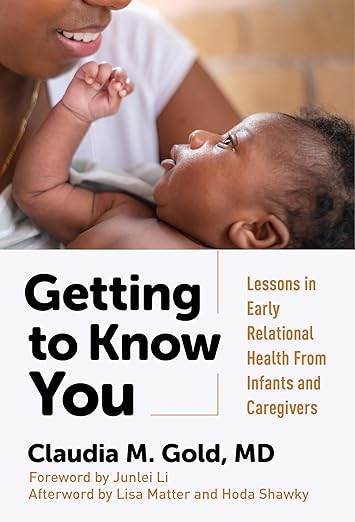
Getting to Know You: Lessons in Early Relational Health from Infants and Caregivers, by Claudia M. Gold, M.D., is just a terrific book. I have worked in the field of infant mental health for many decades, as a clinician, teacher, supervisor, and researcher, and I am familiar with much of the work Dr. Gold synthesizes and integrates. Despite this, I learned from every page. I learned from her remarkably cogent and synthetic descriptions of contemporary developmental theory and science; I learned from her rich depictions of the ways the child, the caregiver, the relationship, and the broader environment contribute to relational health, but mostly I learned from the way she describes her work with families. In one rich clinical vignette after another, the essentials of the work emerge: listening, tolerating uncertainty, and being open to stories. We are in the room with her, absorbing her rich guidance as we struggle to make sense and find meaning.
Like Winnicott and Brazelton before her, Dr. Gold is a pediatrician who began her career in general practice. Time and again she came up against the limitations of “system” and “symptom” checks, longing instead to connect with her patients and their families, and to understand the deeper meanings behind their challenges. The burgeoning literature on infant mental health, relational health, mentalization, and neuroscience transformed her practice, and inspired her writing. Indeed, this is the fifth in a series of books that Dr. Gold (Gold, 2011, 2016, 2017; Tronick & Gold, 2020) has written about mental health practice and developmental science over the last fifteen years. In each, she skillfully translates theory, research, and science into language and ways of thinking that orient the reader to both the “why” and “how” of clinical practice. In Getting to Know You each chapter closes with a summary of its key developmental lessons, along with questions for discussion.
Dr. Gold starts this book with a simple premise, that the practitioner’s capacity to hold a stance of humbly “not knowing” – often in the face of great pressure to do otherwise – is the key to therapeutic change. It is the clinician’s “superpower”. Observing, watching, waiting, and listening are her anchors, even when parents and other professionals demand answers and fixes. Again and again, she helps us see just how this works, using clinical vignettes that bring alive the power of listening, of resisting the urge to do and just be with parents who are at their wits’ end, with children who are often dysregulated and deeply distressed. The vivid clinical examples, which include a description of her own process (acknowledging her feelings, her anxieties, her decisions about what to say), are so familiar and so illustrative of the complexities and the miracles of the work. Tolerating the uncertainty of not-knowing, caregivers and their children are slowly helped to make meaning of the messy pain that brought them into the therapeutic space in the first place.
Dr. Gold also makes clear the value of stories; stories that busy practitioners (of all stripes) are often too busy or too distracted to elicit. It is these stories that bring coherence to all manner of disorganization and dysfunction. As we listen and we hear stories, shame gives way to compassion, anger to openness and connection. Infant mental health practitioners have understood the value of stories since Selma Fraiberg first introduced us to “ghosts in the nursery” (Fraiberg et al., 1975). But it is Gold’s integration of the power of stories with the power of listening, humility, and simply not-knowing, that is so powerful. She describes with great poignancy time and again just struggling to sit, to observe, to not know, to not give advice, but to let the stories emerge in the holding environment she creates. I resonated so deeply with her struggle; creating the space for stories can seem like the hardest job in the world. But the rewards for doing so are great. Dr. Gold also weaves her own personal story of trauma, loss, and remarkable resilience into the book in a way that I found very moving. In this, and in so many other ways, her humanity leaps off the page.
This is a book I would want to read if I were beginning again. This is a book I hope beginners, mid-career and even advanced practitioners will read, too. It is brilliant – clear, synthetic, wise, and smart. It is also profoundly grounding, pointing us again and again to what is most important in the clinical exchange. In this, Dr. Gold brings to life not only the complexity of the work, but its simplicity and eloquence too.
References
Gold, C.M. (2011). Keeping the Child in Mind. Merloyd Lawrence.
Gold, C.M. (2016). The Silenced Child. Merloyd Lawrence.
Gold, C.M. (2017). The Developmental Science of Early Childhood. Norton.
Tronick, E.Z. & Gold, C.M. (2022). The Power of Discord. Little, Brown Spark.
Authors
Slade, Arietta, Ph.D.
Professor Adjunct of Child Psychiatry,
Yale Child Study Center,
United States